
Separate nearby venues from online claims
Location results alone cannot confirm machine access or opening hours, and online availability does not establish Australian licensing.
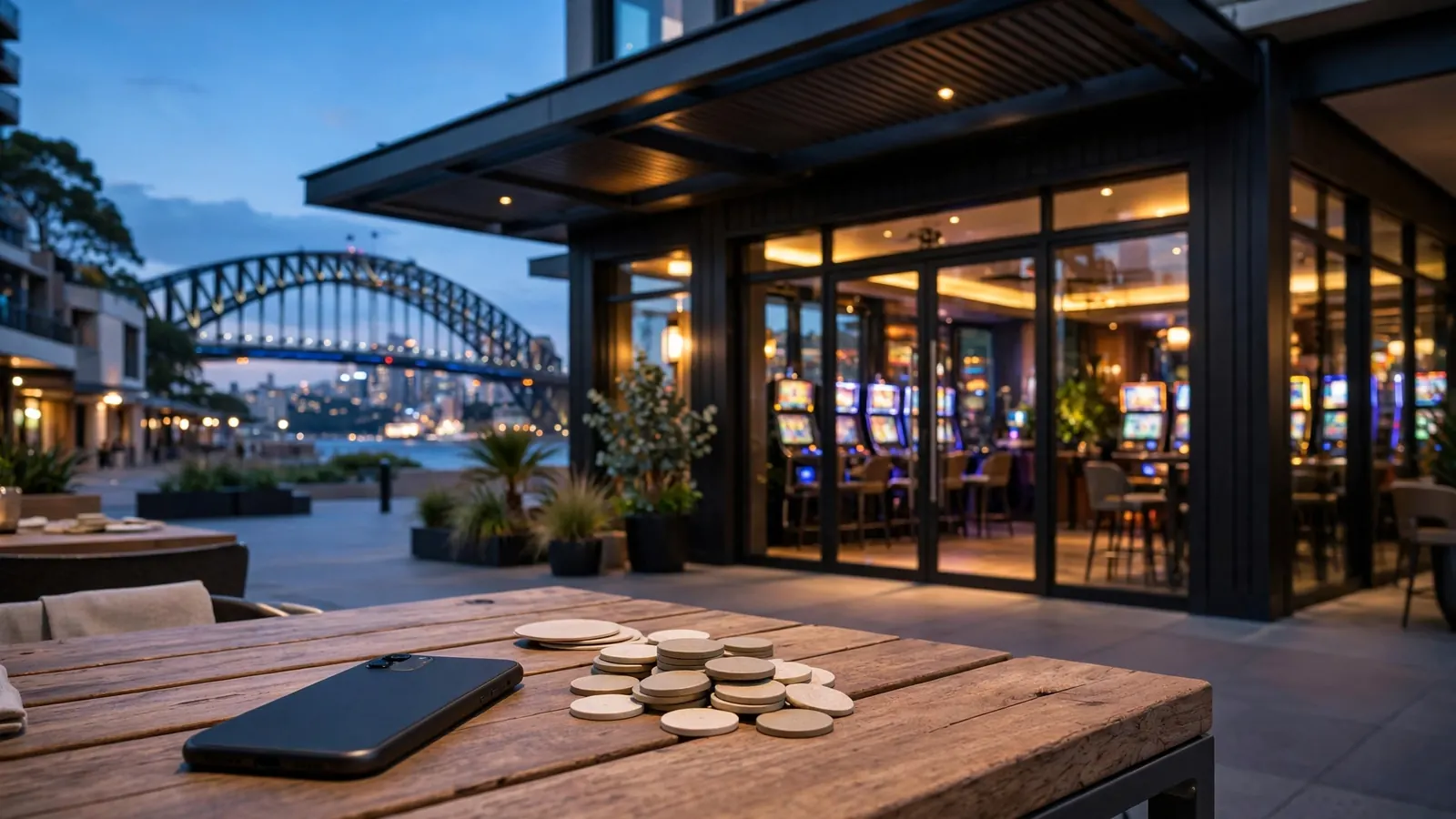
What “Near Me” Means for Sydney Pokies Searches
“Near me” can point to two different things: a physical venue within travelling distance, or an online service that can be reached from a phone or computer. The distinction matters in Sydney because the legal position for an in-person venue is not the same as the position for real-money online pokies.
A request for pokies close to central Sydney, an airport or another local landmark is ordinarily about a place to visit. Its practical meaning depends on where the person is starting from, how far they are willing to travel and what type of venue they have in mind. A map result may identify a nearby business, but proximity alone does not establish that it has gaming machines, that those machines are available to the public, or that it is open at a particular time. Those details require separate confirmation from reliable venue information.
An online result is different. A site may present pokies as available to people in Sydney, but that does not make it an Australian-licensed casino. The Interactive Gambling Act 2001 prohibits companies from providing real-money online casino games, including pokies, to people in Australia. No Australian online casino licences have been issued. There is therefore no domestic licensed online casino to which a Sydney player can turn for real-money pokie play.
Casinos listed by licence
Choosing pokies in Sydney for 2026 means looking beyond the game selection to practical details that can affect how you play and withdraw. Use this list as a starting point, and check each operator’s current terms and availability in Australia before signing up.
-
Roby Casino
- License
- Curacao eGaming (Roby Games Ltd)
Roby Casino is listed with a Curacao eGaming licence held by Roby Games Ltd.
-
Neospin
- License
- Curacao Gaming Control Board OGL/2023/176/0095 (Hollycorn N.V.)
Neospin is licensed by the Curacao Gaming Control Board under OGL/2023/176/0095, with Hollycorn N.V. named as the licensee.
-
WinSpirit Casino
- License
- Curacao eGaming OGL/2024/923/0383 (Antillephone N.V.)
- Min. deposit
- A$30
WinSpirit Casino holds a Curacao eGaming licence, OGL/2024/923/0383, issued to Antillephone N.V. Its minimum deposit is A$30.
-
Vegaz Casino
- License
- Curacao OGL/2024/1335/0780
- Min. deposit
- EUR 20
Vegaz Casino is listed with Curacao licence OGL/2024/1335/0780. The minimum deposit is EUR 20.
-
House of Pokies
- License
- international iGaming licence – jurisdiction not named in the source
- Payout speed
- PayID 1-24 hours
- Min. deposit
- A$30 (PayID from A$10)
House of Pokies lists an international iGaming licence, though the source does not name the jurisdiction. PayID withdrawals are stated as taking 1–24 hours; the minimum deposit is A$30, or A$10 when using PayID.
-
DragonSlots Casino
- License
- Curacao Gaming Authority (Jumpman Gaming Ltd)
DragonSlots Casino is listed with a Curacao Gaming Authority licence held by Jumpman Gaming Ltd.
-
Ricky Casino
- Payout speed
- crypto under 1 hour, PayID 1-3 business days
- Min. deposit
- A$20 (A$30 to qualify for the bonus)
Ricky Casino lists crypto payouts in under an hour and PayID payouts in 1–3 business days. The minimum deposit is A$20, or A$30 to qualify for the bonus.
-
Wild Tokyo
- License
- Curacao
- Payout speed
- crypto 30-60 minutes, fiat 1-5 days
- Min. deposit
- A$10
Wild Tokyo is listed with a Curacao licence. Its stated payout speeds are 30–60 minutes for crypto and 1–5 days for fiat, and the minimum deposit is A$10.
-
Rollero Casino
- License
- Curacao Gaming Control Board OGL/2023/176/0095 (Hollycorn N.V.)
Rollero Casino is licensed by the Curacao Gaming Control Board under OGL/2023/176/0095, with Hollycorn N.V. named as the licensee.
-
Lucky Dreams
- License
- Curacao
- Min. deposit
- A$20 (POLi)
Lucky Dreams is listed with a Curacao licence. Its minimum deposit is A$20 when using POLi.
The legal position needs careful wording. The Act targets the companies providing the prohibited service, rather than making an individual player liable merely for playing. Australians may still encounter offshore sites that accept them, but their availability does not mean those services are authorised to provide online casino games in Australia. Nor does access establish that an operator is subject to Australian casino oversight. The difference is between what a person may be able to access and what companies are permitted to offer.
That distinction also has consequences if a dispute arises. If an offshore casino refuses to pay winnings, Australian players have no legal recourse in Australia against it. A site’s own claims about its status do not create a domestic licence or a local avenue for recovering funds. Accordingly, an online result should not be treated as equivalent to a nearby physical venue simply because both appear under the same broad description of Sydney pokies.
BetStop has a limited role in this context. It applies to Australian-licensed operators and does not bind offshore sites. Since no Australian-licensed online casino exists, BetStop should not be understood as a safeguard that blocks a person from every offshore gambling site or applies to those operators. Its limits are particularly relevant when an online service is presented as local merely because it accepts Australian users.
The wording used to describe a service can blur these categories. “Near” may refer to physical distance, while online access has no meaningful local distance in the same sense. A Sydney-based search for online pokies does not convert an offshore service into a Sydney venue, and a website’s Australian-facing presentation does not establish domestic licensing. Conversely, a listing for a nearby physical venue does not establish anything about online gambling.
A sound interpretation therefore starts with the kind of activity being sought. For a physical visit, the relevant questions concern the actual venue and its location. For online real-money pokies, the central legal fact is that companies are prohibited from offering the service in Australia without a domestic licence, and that no such online casino licences have been issued. Offshore services may accept Australians, but that does not provide the local legal protections available against an Australian-licensed casino—because there is no such casino.
Online Pokies, Randomness and the Limits of RTP Comparisons
A high advertised return-to-player figure does not establish what a particular person will receive from a session. RTP is a theoretical measure of the share of wagers a game is designed to return over a very large number of plays. It is not a forecast for an individual, a guarantee of a minimum payout, or evidence that a particular spin is more likely to win.
Each pokie spin is an independent event determined by a Random Number Generator. A previous win or loss does not make a particular outcome due on the next spin. Nor does a short sequence of results show that a game is paying above or below its stated long-run return. Random variation can produce very different outcomes between sessions, even where the same game configuration is used.
RTP comparisons also depend on whether the figures refer to the same version of a game. A specialist review reports that some providers allow casinos to select among multiple RTP settings for a given pokie. Consequently, the same title may be configured with different return percentages at different casinos. A figure attached to a game name alone may therefore fail to identify the setting in use. The comparison is meaningful only if the specific configuration and its stated return are clear.
Even where a figure is available, it cannot answer questions about how quickly a game might pay, whether a particular stake will produce a win, or how much a player might recover during a single visit. RTP describes an aggregate theoretical return, not the timing or distribution of outcomes for an individual. A game’s apparent performance in a small number of spins is not a dependable basis for judging its longer-run characteristics.
Claims about “best paying” pokies in Sydney, or about games associated with a particular casino, should be read with those limits in mind. A title’s name and an RTP claim do not establish that a specific venue offers a particular version or setting. References to cashless play, high limits, or a maximum bet likewise do not show that a game has a more favourable return. These are separate attributes, and none changes the independence of each spin.

Promotional language can add another layer of confusion. A no-deposit offer, where one is advertised, is not evidence of a game’s return rate or of a likely outcome. Terms attached to an offer may affect how winnings can be used or withdrawn, but they do not alter the Random Number Generator. Comparisons that treat a bonus, a stake limit, or a payment feature as proof of better paying potential conflate distinct matters.
There is also a legal distinction between looking for an online pokie and a lawful Australian service offering it. Under the Interactive Gambling Act 2001, providing real-money online casino games to people in Australia is prohibited for operators, and no Australian online casino licence has been issued. ACMA blocks access to illegal offshore gambling sites, although offshore services may still appear in searches or accept Australian customers. The law targets providers rather than individual players, but a person using an offshore casino has no Australian legal recourse if it withholds winnings.
BetStop applies to Australian-licensed operators and does not bind offshore sites. Its presence or absence therefore cannot establish that an offshore service is safe, lawful to provide, or accountable in Australia. Nor does a payment option or a game’s advertised RTP resolve those questions.
For comparisons of online pokies, the defensible conclusion is narrow: a stated RTP may describe a theoretical setting, but it cannot predict a session, and the same game title may not denote the same RTP configuration everywhere. Claims about likely payouts require more than a game name or headline percentage.
Legal Risk
Under the Interactive Gambling Act 2001, providing real-money online casino games to people in Australia is prohibited, and players using offshore casinos have no Australian legal recourse if winnings are withheld.
Opening Early: What Venue Rules Say About Machine Hours
A venue’s opening time and the hours when its pokies operate are related but distinct details. A venue may open before its machines begin operating, or its machines may stop before the premises close. Consequently, an early opening time alone does not establish that pokies are available at that hour.
The reported responsible gambling requirement concerns staffing during machine operation, not a schedule for Sydney venues. Regionriverina.com.au reports that, from 1 July, venues with more than 20 gaming machines are required to have a dedicated responsible gambling officer (RGO) on duty whenever those machines are operating. The condition attaches to the period of machine operation; it does not set a start time or require machines to run from the moment a venue opens.
This distinction matters when considering claims about pokies available in the early morning. A statement that a hotel is open early would not, by itself, confirm that its gaming machines are running. Nor does the RGO requirement establish that any particular hotel or other venue opens at a specific time. The rule describes a responsibility that applies at qualifying venues once machines are operating.
The same limit applies to searches for a particular morning hour. The staffing condition cannot verify that pokies are available at six or seven in the morning, or that a venue begins operating them at a stated time. Those are venue-specific operating details, separate from the general requirement for an RGO at venues above the machine threshold.
A useful distinction is therefore between premises hours, machine hours and the staffing condition. Premises hours describe when a venue is open; machine hours describe when patrons can use its pokies; and the RGO rule concerns who must be on duty during machine operation at venues with more than 20 machines. Treating these as interchangeable can make an opening-time claim appear more informative than it is.
The rule also does not establish when machines must stop operating. An RGO’s required presence while machines are running says nothing, by itself, about a venue’s closing time or the final hour of play. Claims about late-night availability require the same separation between venue hours and machine hours as claims about early opening.
For an early-hours listing to be meaningful, it needs to distinguish whether the stated time applies to the venue or to the pokies. A broad label such as “open early” cannot resolve that difference. This is particularly relevant to hotels, where a venue’s general trading hours need not describe the operating schedule of its gaming machines.
The responsible gambling officer requirement is a condition attached to machine operation at larger venues, rather than a timetable for Sydney. It provides a narrow operational point: where a venue has more than 20 machines, the reported rule requires a dedicated RGO to be present while those machines are operating. It does not establish which Sydney venues meet that condition, or when their pokies begin operating.
Accordingly, an early opening claim should be read as a claim about a particular venue and, unless stated otherwise, may refer only to its premises. The rule about RGO coverage supplies no basis for converting that claim into confirmation that pokies are running.
Assessing Casino Pokies Without a Verified Venue List
A meaningful comparison of casino pokies depends on what “best” is meant to describe. It could refer to a game’s design, its fit with a player’s preferences, or the chance of receiving a return. Those are different claims, and evidence for one does not establish the others. A list of familiar titles, for instance, would not by itself show which games are available at a particular Sydney venue or which offers the strongest expected return.
The distinction matters when assessing claims about the best-paying pokies in Sydney. A machine’s recent sequence of wins is not evidence that it is more likely to pay next. Each spin is generated as a separate random event, so previous results do not provide a dependable forecast of a future result. A memorable win, a busy-looking machine or a story about a payout may be notable, but none is a sound basis for ranking machines by future returns.
Nor does the word “best” have a single objective meaning. A person may prefer a particular theme, pace or style of play, while another may value different features. Such preferences can describe an experience, but they cannot establish that one pokie pays more than another. A claim about comparative returns requires evidence that is directly relevant to the games being compared, rather than impressions or isolated anecdotes.
Venue-level comparisons require care as well. A general statement about casino pokies does not establish that a named game is installed at a particular Sydney casino, or that the same selection is available across venues. Availability can be a separate question from game quality.
This also applies to the CBD. A location label can make a list sound precise, but it does not establish which machines are present there or how their outcomes compare. The same caution applies to broad descriptions of “Sydney casino pokies”: the phrase does not identify a particular game, machine configuration or measurable advantage.
A defensible assessment would specify its criterion and support it with evidence that matches that criterion. If the claim concerns preference, it should be presented as subjective. If it concerns availability, the relevant venue and game need to be identified. If it concerns paying potential, the comparison must rely on suitable game-level information rather than recent wins or reputation. These categories should not be blended into a single ranking.
For anyone comparing games, the practical distinction is between what can be observed and what can be inferred. A game’s appearance or play style may be described without making a claim about its likely returns. Conversely, a claim that a game is “best paying” is a claim about outcomes and needs more than a compelling title or a report of a past win. Neither a Sydney location nor a casino setting changes the random character of individual spins.
The result is a narrower but more reliable way to discuss the best pokies in Sydney: describe a preference as a preference, and treat a payout ranking as an evidence-based claim that requires specific support. A venue name alone cannot establish a machine’s comparative value, and a winning story cannot show what the next spin will do.

Airport and North Sydney Searches: What Can Be Confirmed
An airport-related request can mean a pokie venue inside an airport, a venue in the surrounding area, or somewhere accessible during a journey to or from the terminals. These are different location claims. The airport name by itself does not establish that a venue is located within the airport, nor that a particular pokie is available there.
The same distinction applies to North Sydney. A reference to the district may describe a venue within its boundaries, a nearby suburb, or a broader route through the area. A location label is not evidence of machine availability: confirming that a venue exists would not, on its own, establish which pokies it operates. Claims about a particular machine therefore require information tied to that venue and machine, rather than a general description of the neighbourhood.
Sydney City presents a similar problem. The phrase can refer to the central business district or be used loosely for a wider part of the city. Treating those meanings as interchangeable risks assigning a venue to the wrong area. A useful location claim needs to distinguish the named place from nearby districts and identify the venue precisely.
The wording “maximum cash payout” also needs to be kept separate from location. Knowing that a pokie is associated with Sydney, the airport area or North Sydney does not establish its maximum payout. A figure attached to a location without identifying the relevant machine and the basis for the figure cannot be treated as a confirmed local limit. The area name is not a substitute for machine-specific information.
For these locations, the distinction between a venue claim and a machine claim is material. A statement that pokies are available somewhere in a district is broader than a statement that a named machine is installed at a specified venue. Neither should be inferred solely from a map label, an area name or a general description of Sydney. A location may be correctly named while the associated claim about a machine remains unsupported.
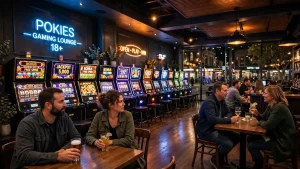
The legal age for gambling in Australia is 18, including for online pokies. That age threshold does not establish the presence of a venue or machine in any particular part of Sydney; it is a general eligibility rule, not location information.
Accordingly, airport, North Sydney and Sydney City should be treated as distinct geographic descriptions, not as interchangeable labels for a confirmed set of pokies. The location wording can indicate what area is being discussed, but it cannot by itself establish a venue, a machine selection or a maximum cash payout.
Crown Sydney Searches and the Evidence Available
Crown Sydney is a specific venue, so claims about its pokies need to be distinguished from general statements about how pokie play works. A title, a game’s reputation or an account of another venue cannot establish which machines are available at Crown Sydney, how they are arranged, or whether a particular room has features that make it the “best” choice. Those are venue-specific details, not qualities that can be inferred from the word “casino”.
The same distinction applies to claims about a particular pokie. A game’s name or advertised theme does not establish that it is installed at Crown Sydney. Nor does a general description of a game show what is currently available at a venue. A claim about a machine selection therefore needs direct, current support tied to the venue; otherwise, it should not be presented as a confirmed feature.
There is one general fact about play that applies regardless of location: each pokie spin is determined by a Random Number Generator and is independent of the previous spin. A run of wins or losses does not establish what the next spin will produce. That fact does not identify Crown Sydney’s machine selection, predict an outcome, or show that one room offers better results than another.
This matters when evaluating descriptions that attach terms such as “best” to a pokie room. “Best” may refer to different things: the range of machines, the room’s setting, accessibility, or some other feature. Without a stated criterion and evidence specific to the venue, the label is subjective rather than a substantiated comparison. It should not be read as evidence that a particular room or machine has superior outcomes.
A careful description of Crown Sydney pokies therefore separates three kinds of statement: what is directly established about the venue, what is generally true of pokies, and what is opinion. Venue-specific claims require venue-specific evidence, while outcome claims cannot be derived from a game’s recent results.
This boundary keeps discussion of Crown Sydney precise. The venue name alone does not establish an inventory, a preferred room, or an advantage in play. General knowledge about random outcomes cannot fill those gaps, and subjective rankings should not be presented as verified descriptions.
Venue Reporting and Responsible Gambling Duties
Assessing a pokie venue involves more than its location or the machines it offers. Operational safeguards provide another relevant measure, although a stated duty does not establish how consistently it is carried out at any particular Sydney venue.
A report published by regionriverina.com.au describes a requirement taking effect from 1 July: venues operating more than 20 gaming machines are to have a dedicated responsible gambling officer (RGO) present while those machines are running. The threshold and the link to operating hours matter. The requirement applies to venues above the stated machine count, and it concerns staffing during machine operation rather than simply having an RGO associated with the venue.
The same report says venues are to maintain a gambling incident register. It is intended to capture occurrences, including situations in which a patron’s behaviour suggests exposure to gambling harm or that harm may already be affecting them. This makes the register an operational record, not just a statement of general policy. Its purpose is to document relevant incidents at the venue.
For someone comparing Sydney pokies venues, these measures provide a basis for asking what procedures exist around staff coverage and incident recording. They do not identify which venues meet the machine threshold, confirm the presence of an RGO at a particular time, or show how a venue responds to an individual incident. Nor do they establish that one venue is the best pokies venue in Sydney. Such conclusions would require venue-specific evidence, rather than an inference from a general requirement.
The distinction between a formal duty and evidence of its implementation is important. A rule can set an expectation for venues within its scope, while a public description of that rule cannot by itself demonstrate compliance at a particular club or casino. The register requirement likewise indicates that incidents are to be recorded; it does not provide a public account of particular entries or outcomes. Venue comparisons based solely on these provisions should therefore remain limited.
Responsible gambling officers and incident records are relevant safeguards, but neither is a measure of game quality or likely returns. They address venue operations and potential gambling harm. A careful assessment of Sydney venues can treat them as relevant criteria without turning a general report into a ranking or claiming that a specific venue’s practices have been verified.
BetStop applies only to Australian-licensed operators and does not bind offshore gambling sites. That limitation concerns online services; it should not be confused with the venue-level duties described here.
Twenty-Four-Hour Searches and Verified Operating Times
A claim that a Sydney venue operates around the clock requires evidence about that venue’s actual schedule. A staffing rule cannot establish such a schedule: it sets a duty that applies while gaming machines are operating, rather than specifying when they must start or stop. The same distinction applies to claims that a venue is open at a particular moment. A requirement tied to machine operation is not confirmation that machines are operating then.
A report published by regionriverina.com.au describes a requirement for venues with more than 20 gaming machines to have a dedicated responsible gambling officer (RGO) on duty while those machines are operating, from 1 July. This is a condition of operation for venues within that category. It does not say that machines must operate continuously, nor does it identify any Sydney venue as open throughout the day and night.
Consequently, the rule cannot substantiate a list of 24-hour pokies venues or confirm that a particular venue is open now. Those are venue-specific claims, and a general rule about staffing does not answer them. A venue could meet the staffing requirement during its operating periods without operating at all hours; the requirement itself does not distinguish between shorter and longer schedules.
The distinction matters when interpreting references to Sydney pokies hours. Regulatory obligations describe what must be in place under specified operating conditions. Opening hours describe a venue’s schedule. Treating one as proof of the other would turn a limited staffing requirement into a broader claim that it does not support.
No venue-specific operating times can be established from this rule alone. It therefore does not verify a round-the-clock schedule for Sydney, or provide a basis for saying that any particular venue is open at the time a claim is made. A dependable statement about those matters would need to identify the venue and rely on current information about its operating schedule. The existence of a responsible gambling officer requirement, by itself, supplies neither detail.
The careful conclusion is narrow: the reported rule concerns the presence of an RGO while machines are operating at venues above the stated machine threshold. It should not be presented as evidence of 24-hour operation, nor as confirmation of a venue’s current status.
Sydney CBD Clubs and Machine-Operation Safeguards
A club’s location in central Sydney does not, by itself, establish which pokies it has or what safeguards apply on site. Claims about a particular CBD venue therefore require venue-specific evidence. General requirements are more informative than an unverified list of clubs.
A report by regionriverina.com.au described a one-month grace period for venues to remove signage and introduce responsible gambling officers (RGOs). This was presented as a transition period, not as evidence that every club had completed the changes. For venues with more than 20 gaming machines, the reported requirement is for an RGO to be on duty while the machines are operating. The distinction matters: a policy announcement or transition period does not confirm the arrangements at an individual venue.
Signage is also subject to location-specific safeguards. Signs directing patrons to gaming lounges must be removed when they are within sight of ATMs or EFTPOS terminals. Signs directing patrons to ATMs must be removed when they are visible from gaming machines. These restrictions concern the placement and content of signs, not proof that a particular CBD club has complied with them.
Self-exclusion is a separate safeguard from signage and on-site staffing. It is among the standard responsible-gambling tools, alongside deposit, loss and session-time limits. BetStop, however, applies only to Australian-licensed operators and does not bind offshore sites. It should not be treated as a universal exclusion mechanism for every gambling service.
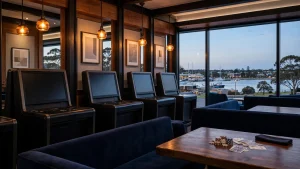
Accordingly, references to clubs or pokies in Sydney’s CBD cannot support a ranking of venues or a claim about their current machine selection. The useful distinction is between general safeguards described for venues and verifiable information about a specific premises. A club name or central-city address alone establishes neither its compliance status nor the practical availability of a particular exclusion measure.
Parkes-Related Searches and the Limits of Location Data
Parkes can refer to more than one place, so a request for pokies associated with Parkes and Sydney does not, by itself, establish which location is intended. It may refer to a place named Parkes in the broader region, or to an area within Sydney. Those interpretations lead to different geographic questions, and the wording alone cannot settle the distinction.
That uncertainty matters when assessing claims about a venue. A place name is not evidence that a particular club, hotel or casino is located there, nor does it establish which machines are available. The same caution applies to descriptions such as “best pokies”: without a clearly identified venue and specific machines, the label cannot support a meaningful comparison. Location should be established before any venue-specific statement is treated as applicable.

The distinction between a physical venue and online play is also important. A reference to a place does not establish that a local pokie venue exists, while online availability does not show that a service is lawful for people in Australia. Real-money online pokies are prohibited services when offered to customers in Australia; this does not change the age rule that applies to gambling.
Across Australia, the minimum legal age for gambling, including online pokies, is 18. That threshold does not confirm the location or operation of a venue, and it should not be read as an endorsement of any form of gambling. Age eligibility and geographic identification are separate questions: the first has a clear national threshold, while the second depends on what place the name Parkes is meant to identify.
A careful description therefore avoids attaching a venue or machine selection to Parkes without a definite geographic basis. The term may be meaningful to a person familiar with a particular locality, but it is not enough on its own to establish where the relevant pokies are. The legal age remains clear; the place reference requires more precision before venue-specific claims can be made.
What’s the best strategy for playing pokies?
No strategy can predict the next spin: each outcome is random, and previous wins or losses do not affect it. RTP describes a theoretical long-run return, not a way to improve the result of an individual session.
What is the cost-benefit calculation of casino promotions?
Compare the wagering requirement with the bonus: a $500 bonus at 40x requires $20,000 in bets before winnings can be withdrawn. If the 35x requirement applies to a $500 deposit plus a $500 bonus, it requires $35,000 in bets; free spins may also have a cash-out cap.
Can casinos change the RTP of their games?
Yes. Some game providers let casinos choose between different RTP settings for the same pokie, so check the stated return for the specific version offered.
How do I know if an online casino is safe to play at?
There is no Australian-licensed online casino, and a site accepting Australian players does not establish that it is locally authorised or overseen. If an offshore casino refuses to pay, Australian players have no legal recourse in Australia.
What is the legal age for online gambling in Australia?
You must be at least 18 years old to gamble in Australia, including on online pokies.