
Plan a Visit Without Assuming the Hotel Is On-Site
Separate casino facilities from nearby accommodation while checking dining, activities and other details relevant to an overnight visit.

Stay, Sleep and Plan an Overnight Visit
A casino visit and a hotel stay are separate arrangements unless the venue identifies accommodation as part of its own operation. The distinction matters: a hotel marketed as being near a casino is not necessarily owned, managed or booked through the casino.
An on-site stay should be described as such only when the property’s official accommodation information connects the rooms to the casino. A nearby hotel is a separate lodging choice, even if its location suits an overnight visit.
The same caution applies to offers described as casino hotel deals. A deal needs identifiable terms, including the property providing the room and the conditions attached to the rate. The phrase “casino hotel” by itself does not establish that a hotel exists at the casino or that a room can be reserved through it.
For an overnight plan, accommodation can be assessed independently from the casino visit. A booking should identify the lodging provider, the location and the conditions that apply to the reservation. If a listing associates a hotel with a casino, the relationship should be clear in the provider’s own description rather than inferred from promotional wording or proximity. This prevents a nearby property from being mistaken for an on-site casino hotel.
Casinos listed by licence
Choosing a casino for Tasmania in 2026 calls for checking the details that matter to you, such as licensing information, deposit requirements and payout methods or timing. Use these operator notes as a starting point and verify current terms before signing up.
-
Roby Casino
- License
- Curacao eGaming (Roby Games Ltd)
Roby Casino is listed with a Curaçao eGaming license held by Roby Games Ltd.
-
Neospin
- License
- Curacao Gaming Control Board OGL/2023/176/0095 (Hollycorn N.V.)
Neospin is listed under Curaçao Gaming Control Board licence OGL/2023/176/0095, held by Hollycorn N.V.
-
WinSpirit Casino
- License
- Curacao eGaming OGL/2024/923/0383 (Antillephone N.V.)
- Min. deposit
- A$30
WinSpirit Casino is listed with Curaçao eGaming licence OGL/2024/923/0383, held by Antillephone N.V. Its minimum deposit is A$30.
-
Vegaz Casino
- License
- Curacao OGL/2024/1335/0780
- Min. deposit
- EUR 20
Vegaz Casino is listed with Curaçao licence OGL/2024/1335/0780. Its minimum deposit is EUR 20.
-
House of Pokies
- License
- international iGaming licence – jurisdiction not named in the source
- Payout speed
- PayID 1-24 hours
- Min. deposit
- A$30 (PayID from A$10)
House of Pokies lists an international iGaming licence, though the jurisdiction is not named. PayID payouts are stated as taking 1–24 hours; the minimum deposit is A$30, or A$10 with PayID.
-
DragonSlots Casino
- License
- Curacao Gaming Authority (Jumpman Gaming Ltd)
DragonSlots Casino is listed under the Curaçao Gaming Authority, with Jumpman Gaming Ltd named as the licensee.
-
Ricky Casino
- Payout speed
- crypto under 1 hour, PayID 1-3 business days
- Min. deposit
- A$20 (A$30 to qualify for the bonus)
Ricky Casino lists crypto payouts under 1 hour and PayID payouts in 1–3 business days. The minimum deposit is A$20, or A$30 to qualify for the bonus.
-
Wild Tokyo
- License
- Curacao
- Payout speed
- crypto 30-60 minutes, fiat 1-5 days
- Min. deposit
- A$10
Wild Tokyo is listed with a Curaçao licence. Its stated payout times are 30–60 minutes for crypto and 1–5 days for fiat; the minimum deposit is A$10.
-
Rollero Casino
- License
- Curacao Gaming Control Board OGL/2023/176/0095 (Hollycorn N.V.)
Rollero Casino is listed under Curaçao Gaming Control Board licence OGL/2023/176/0095, held by Hollycorn N.V.
-
Lucky Dreams
- License
- Curacao
- Min. deposit
- A$20 (POLi)
Lucky Dreams is listed with a Curaçao licence and a minimum deposit of A$20 via POLi.
Room searches also require property-specific information. A room description, availability, rate and booking conditions belong to a particular hotel and date; none can be inferred from the existence of a casino.
Casino hours are another matter from hotel availability. A hotel may accept overnight bookings independently of a casino’s operating schedule, while a casino’s opening times do not establish that accommodation is attached to it. Confirming the casino’s schedule and the lodging reservation as separate details avoids treating one as proof of the other.
The practical distinction is straightforward: an on-site casino stay requires a clearly identified casino-operated accommodation option; a hotel near a casino requires a separately identified lodging property and location. Until a specific property and its terms are established, an overnight visit can be planned only as two separate decisions—where to stay and whether the casino visit fits the schedule—not as a verified hotel package.
Poker Rooms, Tournaments and Casino Facilities
Poker played at a table and pokies are different forms of gambling. Poker involves cards and decisions among players; pokies are Electronic Gaming Machines (EGMs), with each spin determined by a Random Number Generator. A reference to poker machines therefore does not establish that a venue has a poker room, and the presence of poker tables would not establish that tournaments are scheduled.

A poker room, where one operates, is a dedicated area for card play. A tournament is a particular organised format, not simply another name for a room or for cash-game tables. These distinctions matter when interpreting descriptions of casino facilities: a general casino listing, a reference to gaming, or information about EGMs cannot by itself substantiate claims about live poker, tournament dates or table availability.
Poker and Australian online-gambling law
The term “poker” can refer to live play at a physical venue or to an online service, but the legal treatment described here concerns online gambling. Under the Interactive Gambling Act 2001, operators based in Australia cannot provide real-money online casino games to people in Australia. The restricted services include online poker as well as pokies and table games such as blackjack and roulette. This is a restriction on providing the service; it should not be read as confirmation that a particular Tasmanian venue offers live poker.
Offshore websites do not provide a reliable substitute for an in-person poker room. Offshore platforms are not regulated under Australian law, and Australians are legally barred from being offered real-money online casino games by operators. Some sites also restrict access according to a player’s apparent location, determined from their IP address. A game may therefore be absent from a lobby or fail to load because of geographic restrictions. A VPN can make a connection appear to come from elsewhere, but using one to reach region-blocked games breaches the site’s terms and may result in account suspension. That technical possibility does not change the Australian rules applying to operators.
Online Gambling Law
Under the Interactive Gambling Act 2001, operators based in Australia cannot provide real-money online casino games to people in Australia.
Rooms, events and opening status
“Casino rooms” can refer to several different things, including gaming areas or accommodation. The phrase alone is not enough to identify which is meant. Hotel rooms are a separate subject from poker facilities, while a room for card play would need to be identified specifically as such. Likewise, a tournament listing would need to establish the game format and event details; the word “poker” alone does not demonstrate that a scheduled competition is taking place.
Opening status is also time-sensitive. A venue’s general existence, or an old event reference, cannot establish that a particular facility is open on a given day. The same applies to poker tables: operating hours, access arrangements and event schedules can change independently.
The central distinction is therefore between a named facility, a scheduled activity and a general description of casino gambling. Poker rooms and tournaments should not be inferred from references to pokies, nor should online poker listings be treated as evidence of an Australian in-person service. These categories have different meanings, and keeping them separate avoids overstating what a venue provides.
Parking, On-Site Activities and the Online-Casino Distinction
Parking, bingo and dining are distinct practical considerations when assessing a casino visit. The word “casino” alone does not establish that a particular venue provides parking, valet service, bingo sessions or dining facilities. Nor does it establish whether parking is complimentary. Those details should be confirmed through the venue’s current official information before travel, rather than inferred from a general description of a casino in Tasmania.

The same distinction applies to online access. A land-based venue and an online casino are not interchangeable options, and the presence of a casino in Tasmania does not mean that its games are available online to people in Australia. Under the Interactive Gambling Act 2001, operators based in Australia cannot provide real-money online casino games to people in the country. The restriction covers casino-style games such as pokies, blackjack and roulette.
Offshore platforms sit in a different legal position, but that does not make them regulated Australian services. The law’s restrictions apply to operators offering prohibited services to people in Australia, while offshore sites are not regulated under Australian law. Their access may also be blocked for Australian users. These distinctions matter when a venue-related search shifts from parking or activities to online play: the latter is not a lawful Australian casino service simply because an overseas platform can be found on the internet.
A specialist gambling review describes VPN use as a way to make a person’s digital location appear to be outside Australia. That does not remove the underlying restrictions or make access dependable. A platform can detect or block access, and using a VPN to reach region-blocked pokies violates the site’s terms of service and may lead to account suspension. A game may also be unavailable or fail to load because of location restrictions. None of this is a sound basis for treating offshore online casino play as an alternative to a physical visit.
Do
- Confirm parking and dining via official venue information
- Verify current official notices for operating status
- Use discretionary funds for a session budget
Don't
- Assume online availability based on physical venue presence
- Use a VPN to bypass region-blocked games
- Increase stakes to recoup financial losses
For an in-person visit, practical planning should therefore remain separate from assumptions about online availability. Parking arrangements, any valet option, bingo programming and dining access are matters specific to the venue and may change. Current venue information is the appropriate basis for those decisions; a general label such as “casino” cannot establish the details.
The distinction also prevents misleading comparisons. A physical casino’s amenities concern access to a venue, while online casino services concern gambling products subject to Australian law. Searches that combine the two do not establish that the same operator provides both. No online casino games should be presented as available to Australian residents through an Australian-run service.
Gambling should not be treated as a way to meet ordinary expenses or recover financial losses. Any gambling activity carries a risk of loss; increasing stakes to recoup losses can compound that risk. A session budget should be set from discretionary funds, and losses should not be chased.
Accommodation Beyond the Casino
Accommodation described as being near a casino is not necessarily part of the venue. It may refer to an independently operated hotel, motel, apartment or other short-stay property in the surrounding area. That distinction matters: a casino’s name in a property description does not, by itself, establish shared ownership, direct access or a connection between the accommodation and the gaming venue.
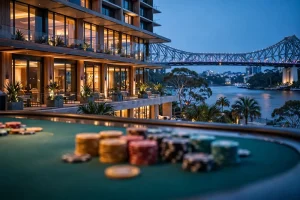
For a stay outside the casino, proximity is best understood through the property’s actual address and route to the intended destination. The word “near” has no fixed distance: a property may appear close on a map but require a longer journey by road or on foot. Map distance, travel time and access arrangements are different measures, so one should not be treated as a substitute for the others. Any comparison should use the specific property and the casino location being considered, rather than relying on a general label.
Tasmania casino accommodation can also describe two different arrangements: a room provided by a casino itself, or a separate place to stay selected for access to a casino. The distinction should be clear before comparing options. A listing that mentions a casino may simply identify a nearby landmark; it does not establish that the venue operates the property or that a casino visit is included in the booking.
Accommodation deals require the same care with wording. A reduced room price, a package and a casino promotion are not interchangeable. A package may combine services, while a promotion may have conditions affecting eligibility or use. The terms attached to a specific offer determine what it includes. A casino-related phrase in an accommodation listing alone does not establish that a discount is available, that it is current or that it applies to a particular stay.
Searches for the location of a Tasmanian casino are relevant to accommodation planning only once the destination has been identified precisely. Tasmania is a state, not a single venue address, and a broad reference to “the casino” cannot establish which property or route is intended. A location should therefore be matched to the particular venue before nearby accommodation is assessed. This avoids treating a statewide label as evidence of local proximity.
The practical comparison is between the accommodation itself and the travel arrangement it requires. Relevant details include the property’s stated address, the route to the intended destination, the booking conditions and the services expressly included. These should come from the property’s own listing or booking terms, not from an assumption based on a casino reference. Without a confirmed property and destination, claims about particular distances, prices or offers would not support a reliable comparison. A separate stay may be a useful alternative to a casino hotel, but the relationship between the two should not be inferred from wording alone.

Contact Details, Bars and Other Venue Searches
Contact details, a map location and venue services answer different practical questions. A telephone number can connect to an operator or a particular department, while an address or map pin identifies a place. Neither, by itself, confirms that a bar, table game or concert is available. These details are best treated separately rather than combined into a single assumption about what a casino offers.
For a contact number or address, the important distinction is between information published by the venue and details repeated in directories or third-party listings. A listing may be out of date, refer to a different department or identify a location without confirming its current operating arrangements. The same applies to map results: a pin can help identify a site, but it is not confirmation of services, access arrangements or current hours. Contact information is most useful when its intended purpose and the venue it identifies are clear.
A casino bar is a venue-specific facility, not something that can be inferred from the word “casino.” The term may also be used loosely for a nearby bar or a bar within a larger entertainment complex. Distinguishing those possibilities matters when checking whether a venue has a particular service, rather than relying on a name or a general description. No claim about a bar’s existence, location or service should be inferred from the phrase alone.

Baccarat and craps are table games, but their appearance in a venue-related search does not establish that either is available at a Tasmanian casino. Nor should table games be confused with pokies, which are a separate form of gambling. Online availability is a different matter again: under the Interactive Gambling Act 2001, operators based in Australia cannot provide real-money online casino games, including table games, to people in Australia. Offshore platforms are not regulated under Australian law, so an online listing should not be read as evidence of an authorised local casino service.
Concert information also requires a distinction between a venue’s general identity and a specific event. A concert listing needs a performer, date and venue to be meaningful; a casino-related description alone does not confirm a programme or schedule. Event details can change, so an old listing should not be treated as evidence that a performance is still planned. The same care applies to promotional material that groups entertainment, gaming and hospitality under one broad venue label.
These distinctions are particularly relevant when several practical needs are being checked at once. An address does not establish a bar; a contact number does not establish a concert schedule; and a reference to baccarat or craps does not confirm that the games are offered in person. Keeping location, contact, entertainment and gaming information separate makes the resulting picture more precise without turning an unverified association into a venue claim.
Breakfast, Buffet, Employment and Rewards Queries
Breakfast and buffet searches concern specific services, not simply the presence of a casino or a resort label. A venue described as a resort may combine different businesses or facilities, and that description alone does not establish that breakfast is served, that a buffet operates, or that either is available to non-guests. Likewise, a reference to a casino buffet does not identify its format, service times or terms of access.

For a breakfast visit, the practical details are whether the service is operating on the intended date, whether it is open to people who are not staying overnight, and whether advance booking or a particular payment arrangement applies. Buffet availability is a separate point: the term can describe a service that is limited to particular days or periods rather than a standing option. Current venue information is therefore more useful than an old listing or a general description, especially where plans depend on a specific service being available.
Employment searches raise a different set of questions. A casino-related job may be advertised by the venue, a contractor, or another business operating on site; the workplace name alone does not establish who the employer is. A credible listing should identify the employing organisation, role, location, duties and employment conditions. Those details matter when comparing a customer-facing position with work in operations, administration or another function. A reference to casino employment is not evidence of an open vacancy, and an outdated advertisement should not be treated as a current opportunity.

The same care applies to broad terms such as “casino resort.” The label does not, by itself, confirm that accommodation, breakfast, a buffet or an employee programme belongs to one operator. Where several businesses are involved, their services and employment arrangements may be separate. The entity named in a listing or offer is therefore important to interpreting what is actually being described.
Rewards searches also require attention to the terms behind the label. The word “rewards” does not establish that a scheme exists, who can join, which activities qualify, or how any benefit is earned or used. If a venue presents a programme, its own published terms should clarify eligibility, exclusions, expiry conditions and the treatment of points or benefits when an account closes. Promotional summaries may omit conditions that affect the value of an offer, so the governing terms take precedence over a headline description.
These categories should not be treated as interchangeable. A breakfast listing concerns a meal service; a buffet listing concerns a particular service format; a job advertisement concerns an employer and a role; and a rewards reference concerns programme rules. None follows automatically from the others, or from a casino or resort description. Keeping those distinctions clear makes it easier to assess whether a listing addresses the actual requirement without assuming that a named venue provides every related service.

Opening Information, Development and Events
Whether a Tasmanian casino is open is a time-sensitive question. An old listing or undated page cannot establish current operating status, and the word “reopening” may refer to a temporary closure, a proposed change or a past event. A reliable status check depends on a current notice from the venue or an authoritative public announcement. Without a dated confirmation, neither opening hours nor a reopening date should be treated as settled.
Development claims require similar care. A proposal, planning process, construction project and completed redevelopment are distinct stages; reporting one does not establish the others. Any account of a Tasmanian casino development should identify the project, its status and the date of the information. In the absence of those details, claims about new facilities, investment or a planned opening cannot support a meaningful comparison.
Entertainment and event information also changes over time. A past performance or event announcement does not establish a continuing programme, while a general description of a venue does not confirm what is scheduled. Current listings need dates and details that identify the event and venue. Without them, there is no sound basis for describing a particular entertainment line-up or calendar.
The same distinction applies to a casino review. A useful review separates observable, dated information from opinion: whether the venue is operating, what facilities are confirmed, and which services or events are current. A score or broad label such as “best” is not a substitute for those particulars. Reviews may also become outdated when operating arrangements or offerings change, so their publication date matters.
Menu references belong to a separate practical question. A menu can change, and a title or image without a date does not establish what is currently served. Dining details are best assessed through current venue information; they should not be inferred from a development announcement or an event listing.
Employment information should likewise be tied to a specific vacancy or formal announcement. A general claim that a venue is hiring does not establish available roles, conditions or recruitment status. Those details need to come from a current employment notice.

Finally, “open” can refer to either a physical venue or online gambling. These are not interchangeable. Under the Interactive Gambling Act 2001, operators are prohibited from providing real-money online casino games, including slots, poker and table games, to people in Australia. A physical venue’s operating status therefore cannot be used to imply that online casino games are legally offered to Australians.
Restaurants and Dining Options
Restaurant information is distinct from the general question of whether a casino has food available. A restaurant listing would need to identify a particular venue and establish what it serves, when it operates and whether it is part of the casino or an independent business nearby. The words “casino restaurant” alone do not settle those details.
The distinction matters when interpreting references to restaurants in Tasmania. A place described as near a casino is not necessarily within the casino, operated by it or open on the same schedule. Likewise, a casino-related dining reference does not establish that a restaurant is currently operating at the venue. These are separate claims and should not be treated as interchangeable.

A useful restaurant entry would specify the venue’s name and location, then provide current details about its service. Menus and opening times can change, so older listings may not reflect present arrangements. Where a restaurant’s own information differs from a general directory listing, the restaurant’s current published details are the more direct source for its menu and hours. This is a general verification principle, not a claim about any particular Tasmanian venue.
Searches for a casino restaurant may also reflect different practical needs: a meal before or after a visit, dining within the venue, or a restaurant in the surrounding area. Those options are not equivalent. An off-site restaurant may require separate travel and planning, while an on-site restaurant would be subject to the venue’s own access and operating arrangements. Without a confirmed venue and current listing, neither arrangement should be assumed.
Restaurant names, menus, prices and service times should therefore be checked against current venue information before being used to plan a visit. A listing that merely repeats the phrase “casino dining” does not establish a particular cuisine, meal service or reservation policy. Nor does a restaurant reference establish that all casino guests can enter or that dining is available during every period the wider venue is open.

For Tasmania, the phrase “casino restaurants” is best understood as a request for specific, verifiable venue information rather than evidence of a particular restaurant offer. Reliable identification requires a named establishment and details attributable to that establishment. Until those are established, claims about restaurant choice, cuisine or availability would go beyond what the wording itself supports. This keeps restaurant searches separate from broader questions about food facilities, buffet service and other amenities, which require their own evidence.
Spa, Location and Dress-Code Searches
A request for a Tasmanian casino’s address is best treated as a location check, not as a description of the venue. Before planning a visit, the relevant casino should be identified by its official name and its address confirmed through an official venue listing. This avoids relying on a similarly named business, an outdated directory entry or a map result that does not clearly identify the property. Directions and transport arrangements depend on the confirmed address, so they should not be inferred from the word “Tasmania” alone.
Spa-related wording raises a separate question: whether a particular venue has a day spa or offers spa treatments. Those are specific facilities and services, not features that can be assumed from a casino’s name or from broader resort language. Treatment options, appointments and access arrangements require venue-specific confirmation before they can be treated as part of a visit.
Dress-code searches concern entry expectations rather than amenities. A policy may differ by venue, area or occasion, and it can change. General assumptions about casino attire therefore do not establish what a particular property permits. The appropriate check is the venue’s own current entry guidance, especially where a visit includes more than one area.
Career searches also need to be separated from general venue information. Employment opportunities, role descriptions and application arrangements are operator-specific and may change over time. A recruitment page or official vacancy notice is a more reliable basis for understanding current opportunities than an old listing or an informal summary. The same care applies to claims about work conditions: they should be assessed from the relevant job information, not inferred from the venue category.

Questions about bars or games may appear alongside searches for an address or dress expectations, but they concern different aspects of a casino visit. Their presence in a search phrase does not establish that a particular bar, game or facility is available at a given property. Each detail needs to be tied to the named venue and confirmed through its own published information.
For practical planning, the useful distinction is between a location, a policy, an amenity and an employment opportunity. Each has a different source of authoritative information: an official location listing, current entry guidance, a venue description or a recruitment notice. Without identifying the property, claims about its spa, address, dress code or careers would remain uncertain.
Food, Food-Court and Pool Queries
Food and pool facilities are separate questions from whether a venue operates casino games. The word “casino” does not, by itself, establish that a Tasmanian venue has a food court, serves food on site or provides a swimming pool. Nor does “resort” in a search phrase demonstrate that a pool or other leisure facility exists.
It would therefore be inaccurate to present either amenity as available, or to describe its location, access conditions or operating arrangements. The same restraint applies to general references to food: they do not establish whether food is sold at the venue or what form any service might take.
These distinctions matter because a food court, a restaurant and a buffet are not interchangeable descriptions. A venue might have one, several or none; the presence of one cannot be inferred from another. Pool access is likewise a separate facility question, not a consequence of a casino being described as a resort or entertainment destination.
For practical planning, the relevant point is that neither food service nor pool access should be assumed without confirmation from the venue’s own current information. This keeps general food and pool expectations distinct from claims about particular restaurants or buffet services, which require their own confirmation.
A cautious description of a Tasmanian casino should consequently avoid implying that a food court or pool forms part of the venue. Search wording can express interest in those amenities, but it is not evidence that they exist. Until a venue provides clear details, these remain unconfirmed practical features rather than established parts of a casino visit.
Are online casino-style games restricted in Australia?
Yes. Under the Interactive Gambling Act, operators based in Australia cannot offer real-money online casino games such as pokies, blackjack or roulette to people in Australia. Offshore platforms are not regulated under Australian law, and games may be blocked for Australian players.
How do online pokies operate?
Each spin is determined by a Random Number Generator (RNG), and spins are independent: previous results do not affect what happens next. RTP describes the theoretical share of wagered money paid back over a very large number of spins.
What is pokies region blocking?
Region blocking uses a player’s IP address to determine their location and restrict games or providers in certain countries. Blocked games may not appear in the lobby or may fail to load for players accessing them from Australia.