
Find out what a $5 deposit can really cover
A low stated minimum may not apply to every payment method, and transaction costs can reduce the balance available for play.
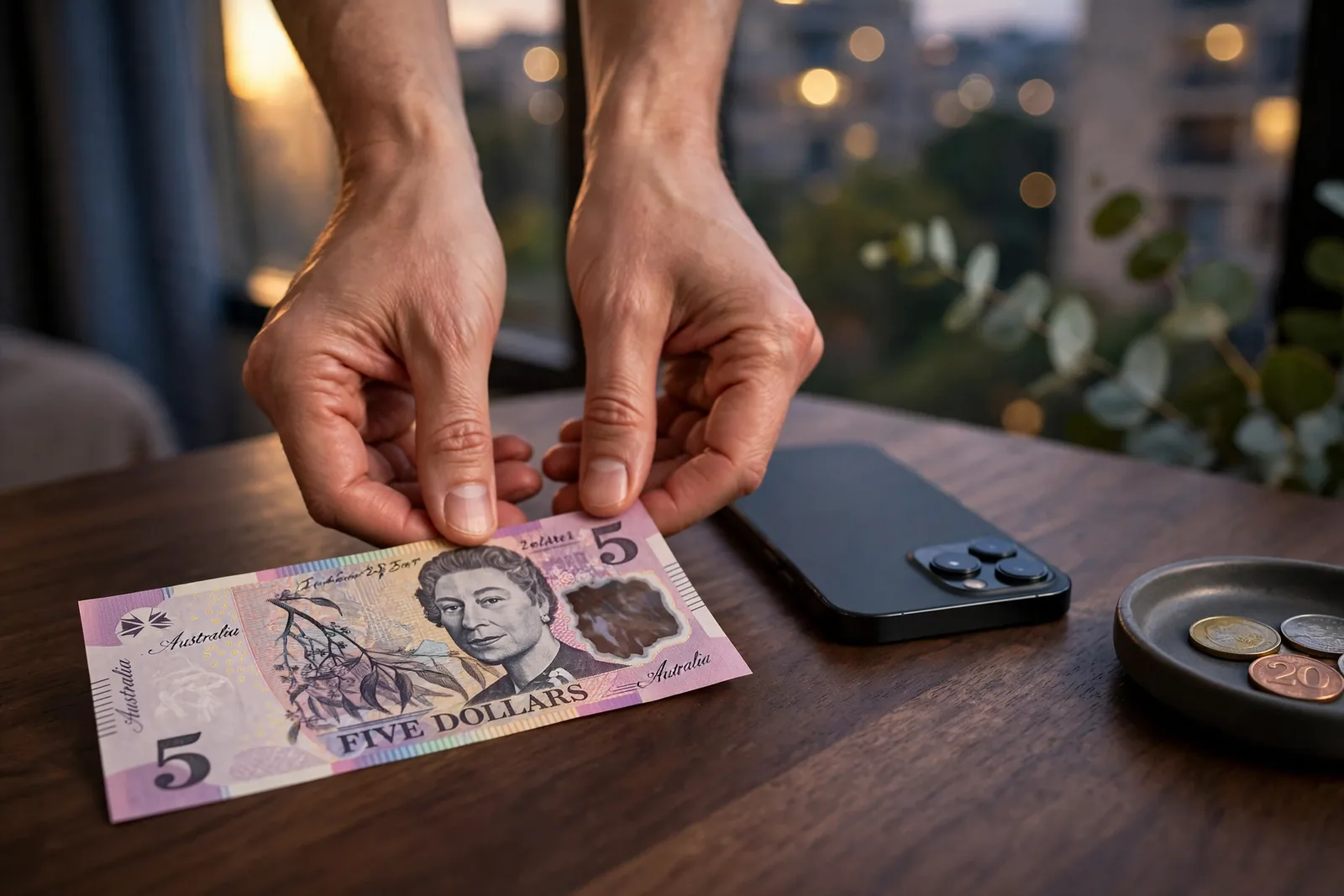
What a $5 Online Deposit Can Actually Buy
A stated $5 minimum describes an entry threshold, not necessarily the amount that can be transferred or the amount that can be used effectively. Those are separate questions. A platform may display a low minimum while the available payment route sets a higher floor; even where a transfer of $5 is accepted, the balance may offer limited practical scope for play.
A specialist review has reported that some offshore operators accept deposits of $5 AUD through cryptocurrency. That is a reported case, not evidence that this threshold is consistently available across operators or payment routes. The amount accepted can depend on the payment option selected, and a minimum shown in general terms may not apply to every method.
Cryptocurrency illustrates the gap between an accepted deposit and a useful balance. A specialist review describes casino-set cryptocurrency minimums as sometimes reaching the equivalent of $1 AUD. That nominal threshold does not establish that a small transfer will be practical: transaction costs can reduce the value that reaches the account, while minimum game bets determine how many opportunities the remaining balance can support. The balance after any costs, rather than the advertised deposit floor alone, is the relevant figure.
Casinos listed by licence
A low minimum deposit can make it easier to try an online casino without committing much upfront. Check the stated deposit threshold and payment-specific conditions to see whether an option fits your budget.
-
Roby Casino
- License
- Curacao eGaming (Roby Games Ltd)
Roby Casino is listed with a Curaçao eGaming licence held by Roby Games Ltd. No minimum deposit amount is provided here.
-
Neospin
- License
- Curacao Gaming Control Board OGL/2023/176/0095 (Hollycorn N.V.)
Neospin is listed under a Curaçao Gaming Control Board OGL licence held by Hollycorn N.V. Its minimum deposit is not specified in the available details.
-
WinSpirit Casino
- License
- Curacao eGaming OGL/2024/923/0383 (Antillephone N.V.)
- Min. deposit
- A$30
WinSpirit Casino has a stated minimum deposit of A$30 and a Curaçao eGaming licence. The deposit threshold is a key point to check if you are looking for a low-entry option.
-
Vegaz Casino
- License
- Curacao OGL/2024/1335/0780
- Min. deposit
- EUR 20
Vegaz Casino lists a minimum deposit of EUR 20 and a Curaçao licence. The amount is stated in euros, not Australian dollars.
-
House of Pokies
- License
- international iGaming licence – jurisdiction not named in the source
- Payout speed
- PayID 1-24 hours
- Min. deposit
- A$30 (PayID from A$10)
House of Pokies lists a A$30 minimum deposit, with PayID deposits available from A$10. PayID payouts are stated as taking 1–24 hours; its licence is described as international, with no jurisdiction named.
-
DragonSlots Casino
- License
- Curacao Gaming Authority (Jumpman Gaming Ltd)
DragonSlots Casino is listed under the Curaçao Gaming Authority, with Jumpman Gaming Ltd named. No minimum deposit amount is provided in the available details.
-
Ricky Casino
- Payout speed
- crypto under 1 hour, PayID 1-3 business days
- Min. deposit
- A$20 (A$30 to qualify for the bonus)
Ricky Casino lists a A$20 minimum deposit, rising to A$30 to qualify for the bonus. Its stated payout speeds are under an hour for crypto and 1–3 business days for PayID.
-
Wild Tokyo
- License
- Curacao
- Payout speed
- crypto 30-60 minutes, fiat 1-5 days
- Min. deposit
- A$10
Wild Tokyo lists a A$10 minimum deposit and a Curaçao licence. Stated payout times are 30–60 minutes for crypto and 1–5 days for fiat.
-
Rollero Casino
- License
- Curacao Gaming Control Board OGL/2023/176/0095 (Hollycorn N.V.)
Rollero Casino is listed under a Curaçao Gaming Control Board OGL licence held by Hollycorn N.V. No minimum deposit amount is provided here.
-
Lucky Dreams
- License
- Curacao
- Min. deposit
- A$20 (POLi)
Lucky Dreams lists a A$20 minimum deposit for POLi and a Curaçao licence. The stated deposit amount is specific to POLi.
This distinction matters because a $5 deposit is a finite balance, not a guarantee of a particular duration or amount of play. If a game requires a stake that consumes a substantial share of the balance, only a limited number of rounds may be possible. If the transfer incurs a cost, the amount available for play may be lower still. No single outcome follows from the deposit amount itself; it depends on the payment route and the rules of the game.
The word “minimum” can therefore refer to different points in a transaction. It may mean the operator’s stated account-funding threshold, the payment provider’s minimum transfer, or the smallest balance that remains useful after costs and game requirements. A figure of $5 in one place does not establish that all three thresholds are $5. Nor does acceptance of a small transfer show that it can be used without restrictions.
A nominally low cryptocurrency threshold is particularly easy to misread when it is quoted in Australian dollars but processed through a digital asset. The amount sent and the amount credited may not be identical once transaction costs are taken into account. The exchange value can also affect how much AUD the credited amount represents. These considerations do not alter the stated minimum, but they affect what that minimum buys in practice.

For a small balance, the relationship between stake size and available funds is more consequential than it is for a larger one. A minimum game bet can make a balance technically usable while leaving little room for repeated play. That is different from saying the deposit is unusable: the relevant point is that acceptance alone does not establish how much activity the balance will support. Without the applicable game rules and payment conditions, a general claim about the value of a $5 deposit cannot be made.
A careful reading of a low-deposit claim should separate the amount advertised from the amount credited and the amount available after any costs. It should also distinguish a minimum that applies to one payment option from a general account minimum. These are matters of transaction mechanics, not evidence that a low deposit offers favourable value or a meaningful amount of play.
Accordingly, “$5 minimum” is best understood as a narrow claim about an entry point, where that amount is actually accepted. It does not, by itself, establish that a $5 transfer is available through every method, that the full amount reaches the account, or that the resulting balance can support extended play. For cryptocurrency in particular, the reported low thresholds sit alongside transaction costs and game-level minimums. The deposit figure alone cannot answer what the balance can actually buy.
Australian Access and the Offshore Context
An “Australian” label on an online casino does not establish that the operator is licensed in Australia or authorised to provide casino games to people located there. Many sites using Australian branding are operated from offshore and rely on licences issued elsewhere, including in Curaçao, Malta or the Isle of Man. The branding may indicate an intended audience, but it does not change the legal status of the service under Australian federal law.

The central federal statute is the Interactive Gambling Act 2001 (IGA). It makes it unlawful for operators to provide prohibited real-money interactive gambling services to customers in Australia. Online casino-style games—including poker, blackjack, roulette and pokies—fall within the prohibited category when offered to people physically located in the country. The prohibition concerns the provision of the service; it is not a general authorisation for offshore operators merely because they hold a foreign licence.
The distinction between operator and customer matters. The IGA does not make an individual’s act of placing a bet with an offshore operator a criminal offence. That does not mean the service itself is lawful in Australia, nor that a foreign licence overrides the federal restrictions. The operator’s regulatory position and the customer’s personal liability are separate questions.
Why offshore branding persists
An offshore licence is granted under the rules of the jurisdiction that issued it. It is not an Australian licence, and it does not displace the IGA. A site may therefore present itself as serving Australians while being regulated, if at all, by a foreign authority. The appearance of Australian currency, local-facing language or an Australia-themed name cannot establish that the service complies with Australian law.
This context is relevant to searches for a $5 deposit Australian casino or a real-money online casino with a low minimum. A deposit threshold describes a payment condition; it does not determine whether the underlying gambling service may lawfully be supplied to people in Australia. Nor does a small deposit change the operator’s obligations under federal law. The amount and the legal status are distinct matters.

ACMA enforcement and access
The Australian Communications and Media Authority (ACMA) is the federal agency responsible for enforcing the IGA and monitoring compliance with interactive gambling laws. Its enforcement work includes action against prohibited services and their advertising. ACMA may ask Australian internet service providers to block websites that provide prohibited interactive gambling services or promote them in Australia.
Since enforcement began in November 2019, ACMA has blocked more than 1,455 illegal gambling and affiliate websites following enforcement actions. That figure indicates that access to offshore sites is subject to active intervention, rather than being assured by the fact that a site can be found online. Blocking measures can affect availability, while enforcement against services and related advertising addresses conduct beyond the simple display of a website.
There is a discrepancy in published counts of services that have left the Australian market after enforcement began in 2017. One count puts the total above 210; another reports more than 190. Both describe withdrawals over the same period, but the figures do not match, so they should not be combined into a single precise total. The difference does not alter the broader point: enforcement has led some services to stop operating in the Australian market.
Legal Status
Under the Interactive Gambling Act 2001, it is unlawful for operators to provide prohibited real-money interactive gambling services to customers physically located in Australia.
A website remaining accessible at a particular time is not evidence that its activities are permitted. Likewise, a foreign licence should not be read as approval from an Australian regulator. The federal framework prohibits operators from supplying the covered casino services to people in Australia, and ACMA has powers to pursue compliance, including seeking website blocking. The practical availability of an offshore site can therefore differ from its legal position.
For Australian residents considering a real-money casino, the relevant distinction is not simply between a $5 and a higher minimum deposit. A low threshold may be advertised by an offshore operator, but it does not make the service lawful to provide in Australia, create Australian licensing, or prevent access restrictions. The IGA and ACMA enforcement apply to the service and its provision in the country, regardless of the branding or the deposit amount.
How to Interpret a Casino’s $5 Minimum
A stated $5 minimum describes a threshold, not necessarily an amount that can be transferred in practice. The distinction is between the amount an operator says it will accept and the amount allowed by the payment route used to make the transaction. If a processor sets a higher floor, a $5 deposit may not be possible through that route, even where the operator’s own terms do not set a minimum.
In this context, “no minimum” and “$5 minimum” can refer to different parts of the transaction. The operator may impose no deposit floor of its own, while a payment method or processor applies one. Conversely, a $5 figure may be advertised as the lowest amount accepted under particular conditions, without establishing that every available payment route supports it. The threshold therefore needs to be read as a claim about the operator’s stated policy, not as a universal promise about payment acceptance.

A specialist review has described the effective minimum for a usable deposit in Australia as falling between A$10 and A$20. That should be treated as a source-specific observation, not a settled market-wide rule: payment arrangements and operator terms can change, and a range reported by one review does not establish what applies to every service. It does, however, illustrate why a nominal $5 minimum may differ from the amount that can actually be submitted.
The key question is what the figure attaches to. A minimum may be stated in general terms, or it may apply only to a particular route or set of transaction conditions. Without that distinction, the headline can make the threshold appear broader than it is. The wording alone does not confirm that a $5 transaction will be accepted from a particular account, in a particular currency, or through every method displayed.
A practical reading separates three stages: the operator’s stated deposit policy, any conditions imposed by the payment service, and the amount ultimately accepted for processing. A low figure at the first stage does not override constraints at the second. Nor does the presence of a payment option establish that it supports the advertised amount. The stated minimum is therefore best understood as an initial limit to verify against the actual transaction terms, rather than a complete description of what can be deposited.
Do
- Verify the operator's stated deposit policy
- Check conditions imposed by the payment service
- Confirm the amount actually accepted for processing
Don't
- Assume a stated minimum applies to every payment route
- Treat a headline figure as a universal payment promise
- Ignore processor-level floors that may override operator terms
This distinction also matters when comparing claims across websites. Two services may both refer to a $5 minimum while applying the phrase to different circumstances: one may describe an operator-level threshold, while another may reflect a specific payment route. Those statements are not directly comparable unless their scope is clear. A deposit figure without that context can be accurate in a narrow sense yet give an incomplete impression of access.
For a $5 minimum deposit claim to be meaningful, it must identify what sets the floor and whether the amount is available through the transaction route in question. If that information is unclear, the advertised figure should not be treated as confirmation that a $5 deposit can be completed. The difference is not merely wording: it separates a published threshold from a usable transaction.
Assessing Claims About the “Best” $5-Deposit Casinos
A casino’s advertised $5 minimum describes only the entry point for a deposit. It does not, by itself, establish that the arrangement is favourable overall. A meaningful comparison would also account for whether the payment can be made at that amount, what costs apply to the transaction, and whether the resulting balance can later be cashed out under the operator’s rules.
A specialist review has reported that some casinos set a cryptocurrency deposit minimum at a nominal level, in some cases equivalent to $1 AUD. That figure concerns the operator’s stated threshold, not the full cost or practical value of a transaction. Network or other transaction costs can reduce the amount that reaches the account, while minimum game stakes can limit how many rounds a small balance supports. A low threshold is therefore evidence only that a small deposit may be accepted under the described conditions; it does not show that the funds are inexpensive to transfer or useful for sustained play.

The distinction matters when comparing claims about the best $5-deposit casinos in Australia. A headline minimum may be accurate while applying only to one payment route, or while leaving other conditions unstated. The relevant comparison is not simply between the lowest advertised figures. It is between the amount debited, the amount credited, any transaction costs, and the conditions attached to using or cashing out the balance. Those details can change the practical value of an apparently identical deposit.
Cashing out introduces a further constraint. A specialist review has reported minimum withdrawal amounts in the $20–$50 AUD range. Such a threshold can exceed the original deposit, so a successful $5 deposit does not necessarily mean that a balance of the same size can be paid out. The account may need to reach the operator’s cashout minimum first. This is a separate condition from the deposit threshold and can materially affect whether a small initial amount is accessible as money outside the account.
Accordingly, a claim that a casino has the lowest $5 minimum deposit is narrower than a claim that it offers the best overall terms. The former concerns entry; the latter would require evidence about the complete transaction and cashout conditions. An advertised minimum may be useful for identifying a possible low-cost starting point, but it cannot establish value without those other terms.

The word “best” also depends on what is being compared. A low entry threshold may matter more to someone testing whether an account accepts a particular payment, while another measure would prioritise low transaction costs or a cashout threshold compatible with a small balance. These are distinct criteria, not interchangeable descriptions of one offer. A ranking based solely on the deposit figure would obscure that distinction.
The soundest interpretation of a $5 minimum is therefore limited: it may indicate that a deposit of that size is accepted in a specified circumstance. It does not, on its own, establish that the deposit can be made without additional cost, that the balance will provide meaningful play, or that it can be cashed out at the same amount. Any assessment of favourable terms has to include the conditions on both sides of the transaction.
First Deposits, Bonuses and Their Conditions
A low first-deposit threshold does not establish that a bonus is easy to use. Promotional funds may come with rules that determine how much must be wagered, which games contribute to that amount, and whether any resulting balance can be cashed out. Those conditions are separate from the deposit minimum and can substantially affect the value of a small deposit.
A specialist review reports wagering requirements of 35x to 50x the bonus amount for low-deposit bonuses. The multiplier applies to the bonus, not necessarily to the deposited funds; the promotion’s terms need to specify the calculation. A larger multiplier means more wagering is required before bonus-related winnings become eligible for cash out. The stated multiplier alone is therefore insufficient to assess the burden: the bonus amount and the rules for counting play also matter.

Game weighting can make the requirement take longer to complete. Pokies may count at 100% of the amount wagered, while blackjack and roulette may contribute only 10% or 20%. Where table games receive lower weighting, a bet of a given size contributes less toward clearing the requirement than the same amount wagered on pokies. The promotional terms should identify eligible games and their respective contribution rates; a general reference to wagering does not establish that all games count equally.
Stake restrictions are another material condition. A promotion may impose a maximum bet while wagering is in progress, and exceeding that limit can void winnings. Some offers specify a maximum stake per spin, so the relevant restriction may apply to each individual play rather than to total spending. Any stated maximum bet should be read alongside the wagering rules, since a permitted stake outside the bonus period may not be permitted while bonus conditions remain active.
A maximum cashout cap can limit the amount payable even when the wagering requirement has been completed. This cap is distinct from both the deposit threshold and the bonus amount. If the terms do not make clear how the cap applies to bonus winnings, the advertised promotion cannot be assessed from its headline alone.
The minimum deposit required to activate a promotion also needs to be distinguished from the casino’s general deposit threshold. A site may accept a small deposit without making that deposit eligible for a particular bonus. The terms should state the qualifying minimum, the wagering multiplier, game weighting, maximum stake during wagering and any maximum cashout. Without those details, a low entry amount says little about the conditions attached to promotional funds.
Does Mobile Access Change the $5 Threshold?
Using a phone or tablet does not, by itself, make a $5 deposit possible. The operator may state that it has no minimum deposit, while the payment method used to fund the account sets a separate floor. That distinction applies whether the transaction is started on a mobile device or elsewhere: changing the device does not remove a payment processor’s minimum.

A figure shown on a mobile page therefore needs to be read as a claim about the operator’s deposit policy, not proof that every available payment route will accept that amount. If a method requires more than $5, the advertised threshold cannot be used through that method. The practical amount depends on the terms attached to the chosen payment route.
For Australian users, a specialist review reported an effective minimum of A$10–A$20 for a usable deposit. This is a report from one review, not evidence of a stable market-wide threshold. It does, however, illustrate why a mobile page displaying a $5 minimum may not settle what can actually be deposited. The payment method’s own rules remain relevant, and those rules may differ between options.
The same distinction applies to searches for a mobile casino with a $5 minimum. A site’s mobile presentation may make its terms visible, but it does not establish that a $5 transaction will be accepted by the payment method. Nor does a mobile label show that the amount is available for every account or route. The available evidence supports no broader claim about app features or mobile-specific deposit processing.
A careful reading separates three things: the amount stated by the operator, any minimum imposed by the payment method, and the amount that can in fact be submitted through that route. Only the second and third determine whether a $5 deposit can be completed in a particular case. A stated minimum alone is not enough to establish that outcome.
The legal position is also unchanged by the device. Under Australia’s Interactive Gambling Act 2001, operators may not provide real-money online casino games to people in Australia. Accessing a service by mobile does not alter that restriction or make the service lawful.
Accordingly, “$5 minimum” on a mobile page should not be treated as a confirmed mobile payment option. It describes, at most, a stated operator threshold; the method’s own minimum still governs whether that amount can be deposited.
Payment Methods, Fees and Delays on Small Deposits
A nominal $5 deposit threshold does not mean every payment route can transfer that amount. Voucher purchase sizes, e-wallet transaction rules and bank-processing delays can each make the amount needed to fund an account higher, or make a small transfer less practical. These constraints are separate from any threshold stated by an operator.
Neosurf
Minimum voucher purchase is typically A$10, which may be higher than the operator's stated minimum.
E-wallets
Skrill and Neteller often have a A$10 minimum transaction amount and may incur fees.
Bank Transfers
These are the least practical for low deposits due to processing delays and potential sending-bank charges.
Neosurf illustrates the difference between a stated deposit minimum and the amount available through a payment method. Its voucher minimum purchase is typically A$10, so a smaller deposit cannot be made using a newly purchased voucher. The relevant floor is set by the voucher purchase, even where an operator’s own stated minimum is lower. A voucher already held may change the immediate outlay, but it does not alter the purchase minimum for acquiring one.
Skrill and Neteller can also impose a higher effective floor. A specialist review reports that deposits to gambling sites through these e-wallets often have a A$10 minimum transaction amount and may incur fees. The exact cost depends on the transaction terms that apply; a fee can reduce the value credited relative to the amount sent. Consequently, an advertised $5 deposit may not be available through either wallet, or may not represent the full cost of making the transfer.
Bank transfers present a different constraint. They are the least practical option for a low deposit because processing can take several business days, while the sending bank may charge a fee. A delay matters even when the amount itself is accepted: the transferred funds may not be available for use promptly. A bank charge can also make a small transfer disproportionate in cost.
The comparison is therefore not simply between payment logos displayed on a page. A voucher can have a fixed purchase floor; an e-wallet can combine a transaction minimum with possible fees; and a bank transfer can add delay and a possible sending-bank charge. The practical amount and timing depend on the conditions attached to the particular route, rather than on the advertised deposit figure alone. These are descriptions of payment mechanics, not recommendations or confirmation that a route is available for Australian residents at a given service.

Why a $5 Minimum May Not Be Practical
A cryptocurrency deposit screen may display a very low minimum, but the amount accepted by the casino is only one part of the cost of making a small deposit. A specialist review has reported that some offshore casinos set crypto deposit thresholds as low as the equivalent of A$1. That is a specific reported case, not evidence that every casino with a $5 minimum deposit will accept that amount through cryptocurrency.
Network transaction costs can reduce the balance available for play. Where a fee applies, its effect is proportionally greater on a small transfer: a modest charge can consume a noticeable share of A$5. The amount received may therefore be lower than the amount sent, depending on the transaction and the service involved. A stated minimum also does not establish that a particular coin or network is available, or that its transaction cost makes a small payment worthwhile.
The playable value of the remaining balance depends on the minimum stake for the game. If the smallest permitted bet is large relative to the balance, only a few rounds may be possible; if it exceeds the available amount, the deposit cannot be used for that game at all. A low threshold on the payment page does not, by itself, show that the money can support meaningful play.
These considerations distinguish a technical minimum from a practical one. A casino may accept a nominal crypto transfer below A$5, while fees and game-level stakes make a $5 deposit difficult to use. The effective cost depends on the particular transaction and game rules, so the displayed deposit threshold alone cannot establish how much play a small balance will provide.
Slots, Wagering and the Minimum Withdrawal
A $5 first deposit does not necessarily make the resulting balance available for cash out. When a bonus is attached, the wagering requirement can determine how much must be staked before bonus-related winnings become eligible for withdrawal. A specialist review reported requirements of 35× to 50× the bonus amount for low-deposit offers. The calculation may apply to the bonus, the deposit and bonus combined, or another defined amount, so the terms’ stated basis matters.
Game weighting also affects how quickly wagering is completed. Pokies generally count the full qualifying stake, while blackjack and roulette may count only 10% or 20%. A stake on a table game can therefore contribute less toward the requirement than the same stake on pokies. These percentages describe contribution to wagering, not the chance of winning or the amount that can be cashed out.
The terms may also restrict the maximum stake during wagering. If a promotion sets a maximum per spin, exceeding it can void winnings. A cashout cap may further limit the amount payable even after the requirement has been met. These conditions can make a small deposit with a bonus materially different from a small deposit without one.
A separate obstacle is the minimum withdrawal. A specialist review reported thresholds in the range of A$20 to A$50, which can exceed an initial A$5 deposit. That does not mean the deposit itself is necessarily lost; it means a balance below the applicable threshold may not yet be payable. The threshold and any bonus restrictions should be read together, since completing wagering does not automatically remove a minimum cashout condition.
In Australia, the Interactive Gambling Act 2001 prohibits operators from providing online casino-style games, including pokies, to people in the country. The mechanics described above explain how bonus and withdrawal terms can affect balances; they do not change that legal position.
PayID, AUD Deposits and Withdrawal Timing
A $5 AUD deposit may not be available through PayID even where a gambling website advertises a low account-level threshold. A specialist review reports that PayID and instant bank-transfer deposits commonly have a minimum in the AU$10–AU$20 range. That is a reported range, not a guaranteed current limit: the payment option and its terms can differ between services.
The distinction matters for searches for a $5 minimum PayID casino. An advertised minimum does not establish that PayID will process that amount. The deposit screen’s stated floor is the relevant figure for the selected method, and a higher payment minimum can prevent a smaller AUD transfer.
Withdrawal timing is a separate issue. A specialist review identifies PayID and cryptocurrency as fast payout routes, reporting that PayID often arrives on the same day. It also reports that USDT sent over the TRC-20 network can clear within minutes after account verification. These are reported timings, not assurances; verification and the service’s processing arrangements affect when funds become available.
In Australia, the Interactive Gambling Act 2001 prohibits operators from providing real-money online casino games to people located in the country. PayID availability or a quoted payout time does not alter that legal position. The payment details therefore describe claims reported about offshore services, not an endorsement or assurance that a service is lawful to provide in Australia.
What payment method is best for small deposits in Australia?
Cryptocurrency can have the lowest entry point: some offshore casinos accept deposits from AU$5, although transaction costs can reduce the amount available to play. Neosurf vouchers typically start at AU$10, while Skrill, Neteller and PayID or instant bank transfers commonly require AU$10–AU$20.
What is the actual minimum deposit at a no-minimum-deposit casino in Australia?
The casino may set no minimum, but the payment method can still impose one. A usable deposit commonly starts at AU$10–AU$20; some offshore casinos accept AU$5 via cryptocurrency.
Are no-minimum-deposit casinos legal in Australia?
The Interactive Gambling Act 2001 prohibits operators from providing certain online casino services to people in Australia, regardless of whether the casino has a deposit minimum. Placing a bet with an offshore operator is not itself a criminal offence for the individual.
What is the minimum deposit and what are the wagering requirements?
A usable deposit commonly starts at AU$10–AU$20, though some offshore casinos accept AU$5 via cryptocurrency. Low-deposit bonuses may require wagering the bonus amount 35 to 50 times before winnings can be withdrawn.
Do low-deposit bonuses have wagering requirements?
Yes. They may require wagering 35 to 50 times the bonus amount; slots usually count fully, while blackjack and roulette may count only 10% or 20%.
Can I withdraw winnings from a low deposit?
Yes, but casinos often set a minimum withdrawal of AU$20–AU$50. Bonus winnings may also be subject to wagering requirements, game-weighting rules and maximum cashout limits.