
Separate parlour claims from casino licensing facts
The phrase is descriptive rather than a separate Australian casino licence, while each casino is licensed in its own state or territory.
What “Pokies Parlour” Means in the Australian Casino Context
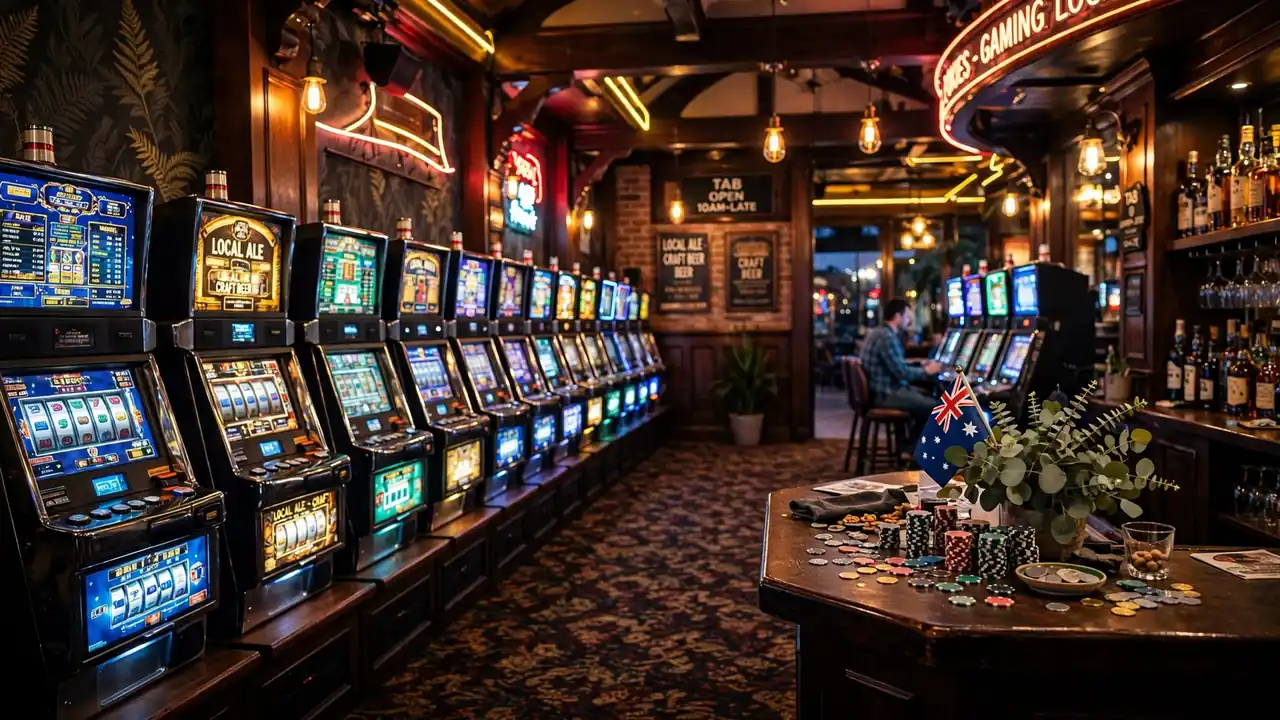
“Pokies parlour” is best understood as a descriptive phrase, not as a separate category of Australian casino licence. In ordinary usage, it can suggest a physical area associated with electronic gaming within a casino, or a venue presented as a place for that kind of play. The wording alone, however, does not establish what a venue is, what it offers or which authority oversees it. In Australia, the relevant distinction is between the broad range of gambling facilities and casinos operating under jurisdictional licences.
The casino industry is regulated by Australia’s states and territories. Each casino property operates under a licence issued by the jurisdiction where it is located. This means the term “parlour casino” should not be treated as a nationwide legal designation with one uniform meaning. A description on a sign, directory or promotional page may indicate how a venue is being presented, but the property’s location and local regulatory framework are more informative about its formal status.
Casinos listed by licence
Choosing a pokies parlour casino for Australia in 2026 calls for attention to the practical details that are actually available, such as licensing, deposit minimums and payout information. Use these concise verdicts as a starting point when considering which options to explore.
-
Roby Casino
- License
- Curacao eGaming (Roby Games Ltd)
Roby Casino is listed with a Curacao eGaming licence held by Roby Games Ltd.
-
Neospin
- License
- Curacao Gaming Control Board OGL/2023/176/0095 (Hollycorn N.V.)
Neospin's listed licence is Curacao Gaming Control Board OGL/2023/176/0095, held by Hollycorn N.V.
-
WinSpirit Casino
- License
- Curacao eGaming OGL/2024/923/0383 (Antillephone N.V.)
- Min. deposit
- A$30
WinSpirit Casino lists a Curacao eGaming OGL/2024/923/0383 licence held by Antillephone N.V. Its minimum deposit is A$30.
-
Vegaz Casino
- License
- Curacao OGL/2024/1335/0780
- Min. deposit
- EUR 20
Vegaz Casino lists Curacao licence OGL/2024/1335/0780 and a minimum deposit of EUR 20.
-
House of Pokies
- License
- international iGaming licence – jurisdiction not named in the source
- Payout speed
- PayID 1-24 hours
- Min. deposit
- A$30 (PayID from A$10)
House of Pokies lists an international iGaming licence, though the source does not name the jurisdiction. Its stated PayID payout speed is 1–24 hours, and the minimum deposit is A$30, or A$10 via PayID.
-
DragonSlots Casino
- License
- Curacao Gaming Authority (Jumpman Gaming Ltd)
DragonSlots Casino is listed with a Curacao Gaming Authority licence held by Jumpman Gaming Ltd.
-
Ricky Casino
- Payout speed
- crypto under 1 hour, PayID 1-3 business days
- Min. deposit
- A$20 (A$30 to qualify for the bonus)
Ricky Casino lists crypto payouts under an hour and PayID payouts in 1–3 business days. Its minimum deposit is A$20, or A$30 to qualify for the bonus.
-
Wild Tokyo
- License
- Curacao
- Payout speed
- crypto 30-60 minutes, fiat 1-5 days
- Min. deposit
- A$10
Wild Tokyo lists a Curacao licence, with crypto payouts in 30–60 minutes and fiat payouts in 1–5 days. Its minimum deposit is A$10.
-
Rollero Casino
- License
- Curacao Gaming Control Board OGL/2023/176/0095 (Hollycorn N.V.)
Rollero Casino's listed licence is Curacao Gaming Control Board OGL/2023/176/0095, held by Hollycorn N.V.
-
Lucky Dreams
- License
- Curacao
- Min. deposit
- A$20 (POLi)
Lucky Dreams lists a Curacao licence and a minimum deposit of A$20 via POLi.
The national landscape is geographically broad. A specialist casino review reports more than 20 full-scale casinos across Australia’s eight states. That figure is a snapshot from a secondary review, rather than a permanent definition of the market: properties can open, close or change status. It nevertheless conveys why a phrase such as “Australian casino” can refer to very different physical settings, from major urban properties to venues in regional centres.
Other location counts require similar care. A specialist gambling directory reports gambling facilities in 147 Australian cities and identifies Sydney, New South Wales, as the country’s largest gambling city, with 11 facilities. These are directory-style counts, not a legal classification of casinos or parlours. The broader category of gambling facilities can include different venue types, so it should not be read as a count of casinos alone. Nor does the presence of a facility in a city establish that it is a standalone pokies parlour.
Individual locations illustrate the variety within the physical casino landscape. Lasseters Casino is located at 93 Barrett Drive in Alice Springs, Northern Territory. Jupiters Gold Coast Casino & Hotel is on Broadbeach Island on the Gold Coast. Country Club Casino is listed at Country Club Avenue, Prospect, in Meander Valley. These are identifiable properties in distinct local settings; their names and addresses do not, by themselves, make “parlour” a formal venue type.
 Real-Money Pokies on Android in AustraliaSee how Australian-facing casinos commonly use mobile websites or PWAs instead of native Android apps, plus free-play options, payments and game terms.
 Australian Mobile Casinos: Access, Offers and PlayCompare browser, PWA and app access, understand how the same account works across mobile and desktop, and review deposits, bonus terms and…
The word “parlour” can imply a contained or dedicated room, while “casino” identifies a broader kind of property. Combining them may therefore be used informally to refer to a casino area associated with pokies, or to a venue described in those terms. But the phrase should not be taken to mean that every Australian casino has the same layout, that every parlour is a separate licensed business, or that all venues using similar language provide identical services. Those conclusions require property-specific information.
This distinction also prevents category errors when comparing locations. A large casino property may include several kinds of spaces and services, while a directory may group facilities under a broad gambling label. A city-level count and a casino-property count answer different questions. The first concerns where gambling facilities are recorded; the second concerns casino venues. Neither count defines “pokies parlour” as a standard national unit.
In the Australian context, then, “pokies parlour” is a useful informal description only when its limits are kept clear. It points toward a physical casino setting associated with pokies, but does not replace the legal and geographic distinctions that identify the venue. State or territory licensing applies to the casino property, while the phrase itself does not determine the licence, layout or regulatory status. The physical setting matters; the label alone is not enough to classify it.
Sign-Up Bonuses and the Limits of Online Casino Promotions
A sign-up bonus is commonly described as a benefit for opening an account, while a no-deposit bonus is presented as something available without an initial payment. Those labels describe promotional claims; they do not establish that the underlying service may lawfully be offered to people in Australia. In the online casino context, the relevant question is not whether an inducement is called a bonus, but whether the service being promoted is permitted under Australian law.
Legal Prohibition
The Interactive Gambling Act 2001 prohibits operators from providing real-money online casino games to people physically located in Australia.
The Interactive Gambling Act 2001 prohibits operators from providing real-money online casino games to people physically located in Australia. The prohibition covers casino-style offerings such as slots, poker and table games. An offer framed as a welcome reward or as a way to try a service without depositing does not change the legal character of the service if it is promoting prohibited online casino gambling. The absence of an initial payment is not, by itself, evidence that the offer is outside the law.
This distinction matters because promotional language can make an online casino offer appear separate from gambling itself. A sign-up reward may be described as an account benefit, and a no-deposit offer may be presented as an opportunity to start without funding an account. Neither description establishes that an Australian consumer can lawfully receive the advertised casino service. The wording of an inducement cannot override the restrictions applying to the activity it is intended to attract.
Advertising is also subject to a separate restriction. Real-money interactive gambling services, including online casinos, must not be advertised to Australian audiences. A bonus claim can therefore raise concerns not only about the service being offered, but also about the promotion of that service. Presenting an inducement as a neutral account feature does not make it unrelated to gambling where its purpose is to draw people towards an online casino.
 Pokies Open Near Me in Australia: Casino HoursMajor Australian casinos operate around the clock, but that does not confirm access to every area or service. Learn how to interpret…
 iPhone Casino Apps in Australia: Legal and Access GuideLearn how Australian law treats offshore casino operators, plus how iPhone access, free-play apps, bonuses and payments differ. The Act targets operators,…
The federal regulator with responsibility for the Interactive Gambling Act 2001 is the Australian Communications and Media Authority, known as ACMA. Its role includes overseeing compliance with federal rules on interactive gambling. This makes ACMA relevant when assessing promotional claims: the issue is not simply whether an advertised reward appears attractive or whether its terms are clearly stated, but whether the service and its advertising fall within the law.
ACMA has a mechanism for seeking restrictions on access to prohibited services and their advertising. It may ask Australian internet service providers to block websites that provide prohibited interactive gambling services or advertise them in Australia. That authority is part of the federal enforcement framework; it does not turn a promotional claim into proof that a service is permitted. Nor does the presence of a sign-up offer establish that the regulator has approved it.
For that reason, phrases such as “pokies parlour sign-up bonus” or “no-deposit casino bonus” should be understood as descriptions used in marketing, not as official categories of lawful Australian online gambling. The term “parlour” does not create an exception to the rules for online casino services. A claim attached to that wording still needs to be considered in light of what is being promoted and whether the promotion targets people in Australia.
It is also important to distinguish an inducement from evidence. A page displaying a reward may show that an operator or promoter is making a claim, but it does not demonstrate that the offer is authorised, that its stated benefit is available under Australian law, or that the promoted service complies with the Interactive Gambling Act. A polished presentation, prominent terms or an apparent account-opening process cannot supply that missing legal basis.
Accordingly, no-deposit wording should not be read as a sign that an online casino offer is lawful or risk-free. The central regulatory question remains whether an operator is providing, or advertising, a prohibited interactive gambling service to people in Australia. ACMA’s federal oversight and its ability to request website blocking provide the relevant enforcement context; the promotional label itself provides no exemption.
Online Play and What Website Access Can Establish
A website associated with a “pokies parlour” may load, display games or accept account details without establishing that it is authorised to provide online casino gambling in Australia. These are observations about a website’s operation, not evidence of its legal status. A working login or an account dashboard shows that the site processes some user activity; it does not show that an Australian regulator has licensed the service.
That distinction matters because the Australian legal framework does not provide for locally licensed real-money online casinos. The Interactive Gambling Act 2001 prohibits operators from supplying online casino-style games, including slots and table games, to people located in Australia. The presence of a casino-style interface online therefore cannot be treated as the digital equivalent of a licensed physical gaming venue.
The phrase “pokies parlour casino online” may refer to several different things: a venue’s information page, an online game demonstration, or a site offering gambling. Those uses are not interchangeable. A page describing a physical venue does not itself provide play, while a game that can be opened in a browser does not thereby become an authorised Australian service. The distinction rests on what the service does and the applicable law, rather than on its appearance or branding.

Website addresses provide similarly limited evidence. A domain name, a familiar logo, or a page that remains available after a link is shared does not establish Australian licensing. Nor does the acceptance of account traffic. These features can show that a service is reachable or operating in some capacity, but they do not demonstrate that its online casino products may lawfully be offered to people in Australia.
Blocking can also make availability appear inconsistent. A domain may fail to resolve through an Australian internet service provider, while another address associated with the same service appears later. A specialist gambling-site review has described alternate addresses emerging over time in this context. That observation should be understood as a report about changing access, not as proof that every replacement address works, is controlled by the same operator, or has any Australian authorisation. Domain changes do not alter the legal character of the service.
This is why “pokies parlour casino play” can be an imprecise description when applied to a website. It may describe access to a physical venue, an online display, or an offshore gambling service. Each interpretation requires different evidence. A venue’s physical casino licence applies within the relevant state or territory framework; it does not, by itself, establish permission to provide online casino games to Australian users.
The same caution applies when a site offers a free-play mode. The ability to load a game without depositing money establishes only that the site presents that mode. It does not establish that the service is an Australian-licensed online casino, and it should not be confused with the status of a physical gaming venue. Whether an online product is lawful depends on the nature of the service and the governing rules, not simply on whether the user is asked to pay at the point of access.
In practical terms, access is a weak indicator of regulatory status. A site may be reachable, unavailable, or presented through a different domain at different times; none of these conditions supplies evidence of an Australian online casino licence. The relevant boundary is legal, not technical: the fact that a website opens on a device cannot convert a prohibited online casino service into an authorised one.
Free Chips and Spins: What the Available Evidence Shows
“Free chips” and “free spins” are promotional phrases, not proof that a gambling service is authorised in Australia or that a particular offer can be used as described. The wording may suggest access to casino-style play without an initial payment, but it does not establish what a promotion involves, whether it is available to people in Australia, or what conditions apply. Those details cannot be inferred from the label alone.
The legal distinction is more important than the promotional vocabulary. Under the Interactive Gambling Act 2001, operators may not provide real-money online casino games to people physically located in Australia. The prohibition covers casino-style games such as slots, poker, blackjack and roulette. A promotion described as a free chip or spin does not, by itself, change the nature of the service being offered. Nor does promotional language establish that an online casino has Australian authorisation.

This is different from a statement about a physical gaming venue. In an online context, “free” can be used to describe an inducement or a form of trial access, but the phrase alone does not show whether play involves a prohibited interactive gambling service. It also cannot establish whether any winnings can be withdrawn, whether a deposit is required later, or what restrictions might apply. Those are terms that would need to be assessed in the context of the service and its legal status, rather than assumed from a headline.
ACMA has taken website-blocking action against illegal gambling services, including alternate domains associated with Fair Go. A specialist review has reported this enforcement activity; the domain references should be understood as an account of blocking action, not as evidence that a service is licensed or endorsed. Blocking can affect access to particular addresses, but a promotion appearing under another address does not turn it into an authorised Australian online casino.
The same caution applies to free-play material circulated through advertisements, affiliate pages or social media. A repeated claim is not independent confirmation, and a prominent offer does not establish that it is lawful to advertise or provide the underlying service to Australians. ACMA is the federal authority responsible for enforcing the Interactive Gambling Act and can take action when prohibited online gambling services are provided or advertised. The existence of promotional wording should therefore be separated from evidence about the service itself.
For a physical casino, promotional language also needs to be read as a claim rather than as a description of the venue’s regulatory status. Australia’s casino properties are licensed by their respective state or territory jurisdictions, while online casino-style services for people in Australia fall under a different legal framework. The words “free chips” or “free spins” do not bridge that distinction.
Accordingly, a claim of free play is best treated as a statement about marketing, not as evidence of an available or permitted Australian online casino offer. The wording alone cannot establish the service’s legal position, the practical terms, or whether the claim is accurate.
How to Read a Pokies Parlour Review
A review of a pokies parlour is most useful when its claims are separated into distinct categories: verifiable information about the venue, descriptions of a reviewer’s experience, and judgements that depend on personal preference. These categories do not carry the same evidentiary weight. A detailed account may still be subjective, while a brief factual statement may be checked against an authoritative record.
In Australia, casino regulation sits with state and territory authorities. Each casino operates under a licence issued by the jurisdiction in which the property is located. That structure matters when a review makes claims about a venue’s status or oversight: the relevant question is whether the claim is consistent with the licensing arrangements of the jurisdiction concerned. A review’s confident tone, polished presentation or repeated use of terms such as “licensed” does not, by itself, substantiate the claim.
Separate fact from experience
Descriptions of atmosphere, service or the layout of a gaming area are generally accounts of experience, not findings that apply to every visit. They can help explain what a reviewer noticed, but should not be treated as an objective measure of quality. The same applies to broad labels such as “best” or “premium”: without a clear basis for comparison, these express a judgement rather than a verifiable conclusion.

Factual statements should be more specific. A review that identifies the relevant state or territory and explains the basis for a licensing claim is more informative than one that leaves the jurisdiction unclear. Even then, the claim should be distinguished from the reviewer’s assessment of the venue. Licensing is a regulatory matter; praise or criticism of the experience is not evidence of regulatory standing.
Reviews also vary in how clearly they disclose the basis of their conclusions. First-hand observations, information attributed to the venue, and general commentary should not be blended into a single account. Where the text does not make those distinctions, the reader cannot reliably tell which statements are observations and which are interpretation.
What a review cannot establish
A review is not a substitute for the licensing authority’s role, nor does a positive evaluation demonstrate that every statement in it has been independently confirmed. Conversely, a critical review does not establish a regulatory breach. Those conclusions require evidence suited to the claim, rather than a star rating or an overall verdict.
Care is also warranted when a review uses promotional language while presenting itself as neutral analysis. Commercial tone alone does not prove that a factual claim is wrong, but it makes the basis for recommendations and comparisons especially relevant. A responsible reading focuses on what the text actually supports, rather than allowing a favourable summary to stand in for evidence.
A useful pokies parlour review therefore identifies the venue and jurisdiction, distinguishes factual claims from personal impressions, and makes the limits of its assessment apparent. If it does not, its conclusions should be read narrowly. That approach does not rank Australian casinos; it clarifies what a review can—and cannot—show.
Do
- Separate verifiable venue facts from personal experience
- Identify the specific state or territory jurisdiction
- Distinguish factual claims from subjective assessments
Don't
- Treat subjective labels like "best" as objective measures
- Use a star rating as evidence of regulatory standing
- Blend first-hand observations with general commentary
Australian Casinos: Regional Coverage and Operating Hours
Australia’s casino network is distributed across state and territory jurisdictions, but a national picture should not be mistaken for an even spread of venues. The available location figures are more specific for the Northern Territory than for other regions. A specialist review lists three casinos across three Northern Territory cities. In that same account, Alice Springs has one casino, the highest city-level count reported there. These are figures from a particular review, not a complete or permanent census of the territory’s gaming venues.
The Alice Springs listing identifies Lasseters Casino at 93 Barrett Drive, Alice Springs, NT 0870. That address provides a concrete example of a casino located outside a major metropolitan centre. It does not, by itself, establish how accessible the venue is to people in other parts of the Northern Territory, or how its facilities compare with those in other cities. The regional figures are therefore useful as a limited snapshot rather than as evidence of uniform coverage.
Operating hours offer a separate measure of access. All major Australian casinos operate around the clock, so their opening hours are not confined to daytime or evening sessions. This describes the operating schedule of major casinos as a category; it does not establish that every service within a property is available at every hour. Nor does continuous operation remove the practical effects of distance, transport, local conditions or a venue’s entry requirements.
For physical entry, valid photo identification is required at all major Australian casinos. The requirement applies regardless of whether a venue is in a capital city or a regional location. Consequently, a casino’s stated operating hours should not be read as a guarantee of entry for every person arriving at any time. The hours indicate when a major property operates, while admission remains subject to the venue’s entry process.

The Northern Territory figures also illustrate why regional comparisons need care. A count of casinos by city can make a small or dispersed market appear straightforward, yet the number of facilities alone says little about travel distances or the breadth of services available. The specialist review’s listing places one casino in Alice Springs, but it does not provide enough information to map access across the territory or compare local operating conditions. No broader conclusion about regional availability follows from that count.
In practical terms, the evidence supports two restrained observations: major Australian casinos operate 24 hours a day, and a specialist review reports three Northern Territory casinos across three cities, with Alice Springs listed as having one. These points describe operating hours and a reported geographic snapshot, not a guarantee of equal access across Australia. Regional coverage is best understood through venue-specific location information, while the stated round-the-clock schedule applies to major casinos rather than every gaming venue.
Bonus Claims and ACMA Enforcement
A bonus advertised in connection with a pokies parlour may sound like a routine feature of gambling, but the promotional wording alone says little about whether the service behind it is lawful in Australia. Enforcement activity provides a broader context: the Australian Communications and Media Authority (ACMA) acts against illegal gambling services and websites that promote them. A claim about a parlour bonus should therefore be read as an advertisement, not as evidence that the associated online service is authorised.
ACMA reports that, following enforcement action, it has blocked more than 1,455 illegal gambling and affiliate websites since November 2019. The figure indicates the scale of intervention, but it does not establish that every blocked website carried a bonus offer or that every bonus advertisement involved the same type of service. Blocking action may concern the provision of prohibited gambling or the promotion of such services.
There is also a reported discrepancy in the number of illegal services that have left the Australian market since ACMA began enforcing the rules in 2017. One figure states that more than 210 services withdrew; another gives the total as more than 190. These accounts should not be collapsed into a single precise count. Both describe withdrawals over the period, but the disagreement means the exact reported total cannot be treated as settled.
The distinction between a website, an affiliate and a gambling service matters when interpreting these figures. A site may promote a service without operating it, while enforcement against a promotional website does not by itself identify the terms or source of any bonus claim. Conversely, a claim that appears alongside a familiar parlour label does not establish a connection to a licensed physical casino. The label and the offer are not substitutes for evidence about the service being promoted.
In this context, the phrase “pokies parlour bonus” is best understood as promotional language whose meaning depends on the service and setting to which it refers. ACMA’s enforcement record shows that illegal gambling and affiliate activity has been subject to substantial blocking and withdrawal action. It does not validate a particular bonus, certify an advertiser, or imply that an online casino promotion is permitted. The figures are useful as evidence of regulatory activity, not as a measure of the legitimacy or availability of an individual offer.

VIP Parlour Access and the Entry-Age Boundary
VIP access at a casino does not replace the national minimum age for entry. Across Australia, casino entry is restricted to people aged 18 or older. A VIP label therefore cannot be read as an exception to that threshold.
The age boundary is a basic condition of physical access, not a description of membership benefits. It does not, on its own, establish how a casino defines VIP status, whether membership is available, or what additional areas or services a particular tier may include. Those details depend on the relevant venue’s arrangements and should not be inferred from the phrase “VIP parlour”.
Entry controls also apply independently of promotional language or a person’s claimed status. Major Australian casinos require valid photo identification for entry. A VIP designation is not a substitute for identity and age checks, nor does it establish that access to every part of a property is permitted.
This distinction matters because “VIP” can suggest a special category of access while leaving the actual conditions unclear. The nationwide age threshold is consistent; any further eligibility criteria or benefits are venue-specific and cannot be treated as universal. Descriptions of a VIP casino area should therefore be understood as labels, not as evidence of a separate age rule or a guaranteed entitlement.
For an Australian casino setting, the defensible baseline is straightforward: entry begins at 18, with valid photo identification required at major casinos. Claims about privileges attached to VIP access need to be assessed separately from that age requirement. Neither the label nor a general description of a parlour changes the entry-age boundary.
Parlour Pokies in the Licensed Casino Setting
In Australian casino usage, “pokies” refers to gaming machines, while “parlour” suggests a designated area or setting where such machines are found. The phrase can therefore describe a physical casino environment, but it should not be taken as evidence that a separate, nationally standardised venue category exists. Casino layouts and terminology may differ between properties.
A national measure provides a clearer point of reference: 3,308 gaming machines are endorsed on venue licences and installed in casinos across Australia. This figure concerns machines in the casino sector. It does not describe every gaming machine in the country, nor does it indicate how many are located in any particular parlour or room.

The licensing context matters. Australian casinos operate under licences issued by their respective state or territory jurisdictions. The national total brings together machines recorded in casino settings, but it does not replace the local licensing arrangements under which individual properties operate. “Parlour pokies” is best read as a descriptive phrase for casino-based gaming machines, rather than as a separate licensing designation.
The count also describes installed machines, not visitor numbers, machine use or gambling outcomes. It cannot establish how busy a parlour is, what facilities are available nearby, or what a particular property’s internal layout looks like. Those questions concern individual venues and should not be inferred from the national figure.
This distinction helps keep the terminology precise: the parlour is a physical setting, while the count refers to licensed and installed gaming machines in Australian casinos. The figure supplies national context for the scale of that casino-machine category without suggesting that all properties organise their gaming areas in the same way.

Real-Money Casino Claims and Australian Licensing
A claim that an online pokies parlour offers real-money play describes a service, not evidence that the service is licensed in Australia. Account registration, deposits or other account activity do not establish local authorisation. Nor does an operator’s use of language associated with a physical casino change the legal character of online gambling.
Under the Interactive Gambling Act 2001, operators must not provide real-money online casino games to people located in Australia. Casino-style services covered by the prohibition include slots, poker and table games such as blackjack and roulette. The distinction is therefore not simply between a site that calls itself a casino and one that uses another label: the relevant question is whether it provides prohibited interactive gambling to customers in Australia.
A website may load, accept account traffic or appear at an alternate address without becoming an Australian-licensed online casino. Those signs show only that a user can interact with a website; they do not demonstrate that the service has a lawful Australian casino licence. The same applies to promotional descriptions of “real-money” play. Such wording should not be treated as proof of approval, consumer protection or a domestic licensing arrangement.
The term “pokies parlour” can refer to a physical gaming setting, but applying it to an online real-money service does not make the online activity equivalent to play at a licensed Australian casino. The regulatory framework for land-based casinos is administered by state and territory jurisdictions, while the federal law prohibits operators from supplying real-money online casino games to people in Australia.
Accordingly, real-money claims need to be read as claims about the nature of the service, not as evidence of Australian licensing. Access and account activity cannot supply that evidence, and terminology alone cannot alter the legal status of the offering.