
Check the route from AUD to a casino balance
Australian access typically means buying SOL through an exchange before sending it to an offshore casino wallet.
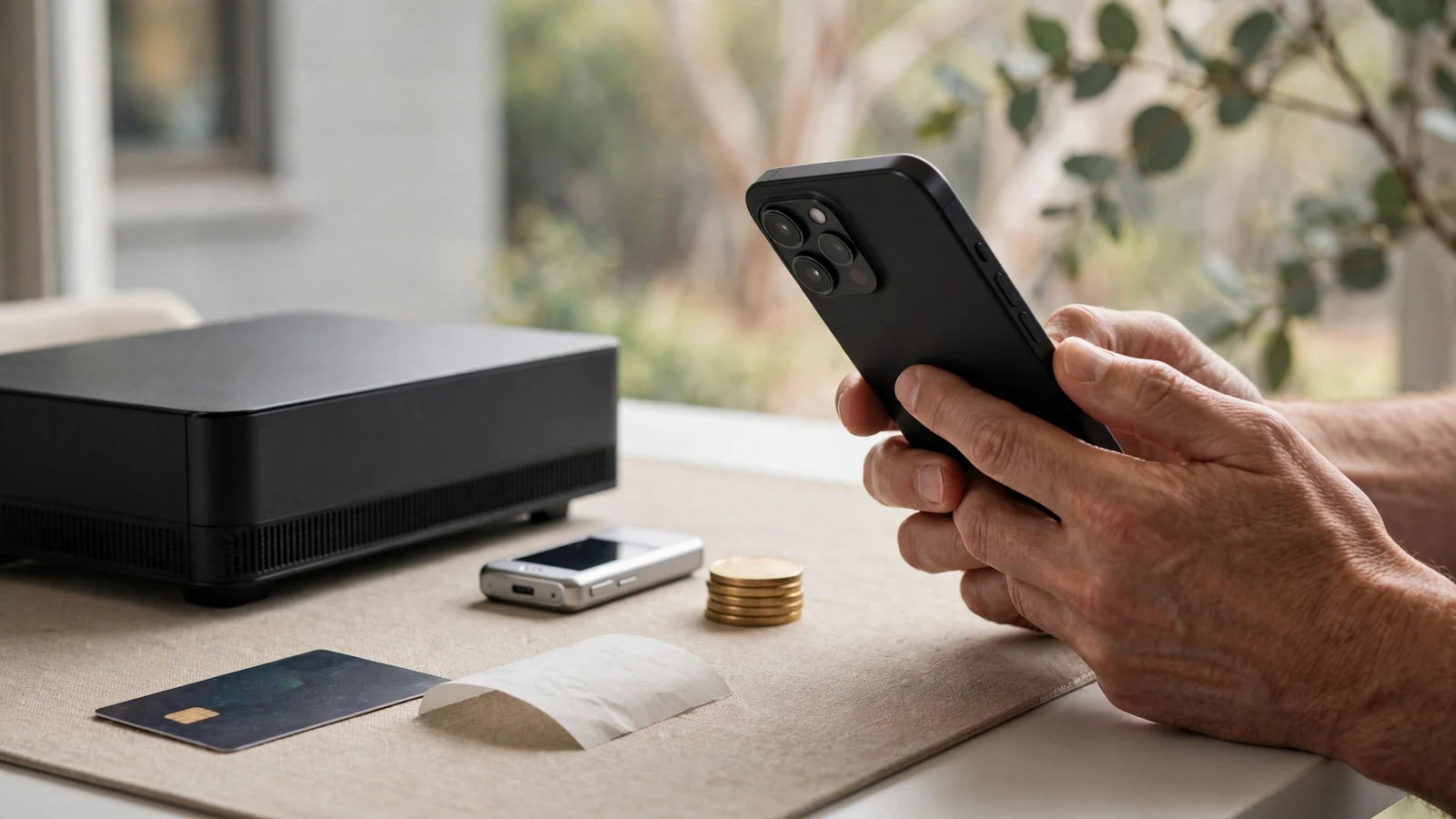
How Australian Players Fund a Solana Casino Account
Funding a Solana casino account from Australia generally involves a conversion step: Australian dollars are deposited with a local crypto exchange, exchanged for SOL, then transferred to a wallet address supplied by an offshore casino. The casino balance is credited only after the platform recognises the transfer. This route differs from a conventional online payment, where AUD moves directly from a bank account or card to a merchant.
Most Solana casinos do not accept direct AUD deposits by bank transfer or credit card. Australian players therefore need to acquire SOL before attempting a deposit. Swyftx, CoinSpot and Coinbase AU support AUD funding through PayID or bank transfer. The available payment method and account requirements should be checked with the exchange, since a supported funding option does not itself establish that a particular transaction will be accepted or processed in a particular way.
From AUD to a casino balance
The process has distinct stages, each involving a different service:
- AUD is sent to an Australian exchange using a supported method, such as PayID or bank transfer.
- The AUD balance is used to purchase SOL.
- SOL is sent from the exchange or a personal wallet to the casino’s stated Solana deposit address.
- The casino credits the account after it detects the transfer.
Casinos listed by licence
When comparing Solana casinos in Australia for 2026, check the payment options and licensing information that are actually available, and confirm Solana support directly. The details below provide a concise reference for the listed operators.
-
Roby Casino
- License
- Curacao eGaming (Roby Games Ltd)
Roby Casino is listed with a Curacao eGaming licence held by Roby Games Ltd. The information provided does not specify Solana support.
-
Neospin
- License
- Curacao Gaming Control Board OGL/2023/176/0095 (Hollycorn N.V.)
Neospin is listed under Curacao Gaming Control Board licence OGL/2023/176/0095, held by Hollycorn N.V. The information provided does not specify Solana support.
-
WinSpirit Casino
- License
- Curacao eGaming OGL/2024/923/0383 (Antillephone N.V.)
- Min. deposit
- A$30
WinSpirit Casino is listed under Antillephone N.V.’s Curacao eGaming licence OGL/2024/923/0383, with a minimum deposit of A$30. Solana support is not specified in the available details.
-
Vegaz Casino
- License
- Curacao OGL/2024/1335/0780
- Min. deposit
- EUR 20
Vegaz Casino is listed under Curacao licence OGL/2024/1335/0780 and has a minimum deposit of EUR 20. The available details do not establish whether Solana is supported.
-
House of Pokies
- License
- international iGaming licence – jurisdiction not named in the source
- Payout speed
- PayID 1-24 hours
- Min. deposit
- A$30 (PayID from A$10)
House of Pokies has an international iGaming licence, though the jurisdiction is not named in the source. Its stated PayID payout speed is 1–24 hours, and the minimum deposit is A$30, or A$10 via PayID.
-
DragonSlots Casino
- License
- Curacao Gaming Authority (Jumpman Gaming Ltd)
DragonSlots Casino is listed under the Curacao Gaming Authority, with Jumpman Gaming Ltd named. The available information does not specify Solana support.
-
Ricky Casino
- Payout speed
- crypto under 1 hour, PayID 1-3 business days
- Min. deposit
- A$20 (A$30 to qualify for the bonus)
Ricky Casino lists crypto payouts under 1 hour and PayID payouts in 1–3 business days. Its minimum deposit is A$20, rising to A$30 to qualify for the bonus.
-
Wild Tokyo
- License
- Curacao
- Payout speed
- crypto 30-60 minutes, fiat 1-5 days
- Min. deposit
- A$10
Wild Tokyo is listed with a Curacao licence, a minimum deposit of A$10, and stated payout times of 30–60 minutes for crypto and 1–5 days for fiat. The available details do not specify Solana support.
-
Rollero Casino
- License
- Curacao Gaming Control Board OGL/2023/176/0095 (Hollycorn N.V.)
Rollero Casino is listed under Curacao Gaming Control Board licence OGL/2023/176/0095, held by Hollycorn N.V. The information provided does not specify Solana support.
-
Lucky Dreams
- License
- Curacao
- Min. deposit
- A$20 (POLi)
Lucky Dreams is listed with a Curacao licence and a minimum deposit of A$20 via POLi. The available details do not establish whether Solana is supported.
On-ramp services that convert AUD into SOL are subject to KYC/AML requirements. This means identity and transaction checks may form part of using an exchange or other conversion service. The checks belong to the financial service involved; they should not be confused with the casino’s own account procedures.
The destination address and network are central to the transfer. SOL transactions are irreversible, so a transfer sent to the wrong address can result in permanent loss. A deposit should not be initiated until the wallet address and the required asset and network have been checked against the casino’s deposit instructions. A valid transfer to an address that is not controlled by the intended platform does not provide a reliable route to recovery.
Deposit size and price exposure
A specialist casino review reports minimum SOL deposits in a range of 0.01 to 0.1 SOL, equivalent to approximately AUD$2.80–$28 at April 2026 prices. This is a reported range, not a fixed minimum that applies to every platform or remains constant as the SOL price changes. The amount required in AUD can move with the token’s market value, while a casino may specify its deposit threshold in SOL.
The size of an exchange purchase and the casino’s minimum deposit are separate considerations. A purchase may need to cover the intended casino transfer as well as any exchange-side requirements, but the relevant conditions depend on the services being used. An amount that appears to meet a stated casino minimum may also be affected by changes in SOL’s AUD value between purchase and transfer. The value of funds held as SOL can therefore fall before they are used, and winnings held in SOL can lose value before any later conversion to AUD.
 Same-Day Payout Casinos in Australia: Withdrawal TimesCompare reported timelines for e-wallets, cards and bank transfers, and see why processing speed does not guarantee same-day receipt.
 Casino Sites That Accept BPAY in AustraliaLearn what the available evidence does and does not confirm about BPAY deposits, withdrawals and casino cashier support, without unsupported rankings.
The phrase “Solana casino coin” can refer loosely to the token used to fund play, but SOL is the network’s native token; the phrase does not identify a separate, standard casino currency. A casino account balance denominated in SOL represents a platform credit, while the underlying transfer is made in SOL to a wallet address. The distinction matters when checking what asset is requested and how an account displays its balance.
Legal and practical limits
The Interactive Gambling Act 2001 prohibits offshore operators from providing online casino games to people in Australia. Australians may legally buy, hold and transfer SOL, but using SOL at an offshore online casino remains in a legal grey zone. The Act targets operators rather than individual players, so players are not directly penalised under it for using offshore casinos. That does not make the activity legally safe: offshore services are prohibited from serving Australian residents, and protections available under Australian law are limited if funds are withheld or a platform closes.
A VPN does not change the operator’s legal position and may expose an account to seizure and loss of funds. Offshore casino accounts also do not provide the same recourse through Australian authorities as a domestic service. These limitations remain relevant before any transfer, because crypto transfers cannot be reversed simply by disputing a payment through a bank.
Legal Risk
Under the Interactive Gambling Act 2001, offshore operators are prohibited from providing online casino games to people in Australia, and such services offer limited consumer protection.
Funding should therefore be understood as a sequence of separate transactions, not as a direct AUD payment to a casino. The exchange handles the AUD-to-SOL conversion; the wallet sends SOL; and the offshore platform decides whether to credit the deposit. Each step carries its own conditions, while the token’s changing AUD value affects the amount represented by the balance.
What a Solana Casino Comparison Can—and Cannot—Establish
A comparison of Solana casino services can be useful only when it distinguishes documented terms from promotional claims. A table of features may make platforms look directly comparable, but the underlying evidence can differ: one condition may be stated in published rules, another inferred from marketing, and another left unclear. A defensible assessment identifies what is actually documented and avoids treating missing information as a favourable feature.
The same caution applies to broad claims about the best Solana casino or the best crypto casinos using Solana. A comparison can organise evidence about stated conditions; it cannot establish that a platform is safe, reliable or suitable merely by assigning it a high position. Nor does a shared payment method establish that services have equivalent rules, consumer safeguards or operating practices. Without consistent, platform-specific evidence, a ranking risks presenting uncertainty as precision.
Bonus terms offer one area where comparison can be more analytical. A specialist review describes assessing bonus value by considering the playthrough requirement, which games count and at what contribution, the time limit, and any cap on cashout. These conditions affect whether a headline offer has practical value. A bonus with an attractive face value may be less useful if eligible play is restricted, the completion period is short, or the cashout cap limits what can be retained.

That assessment should not rely on the wagering multiple alone. The amount of qualifying play depends on the requirement and on how each game contributes. If terms do not explain which funds are subject to wagering, which games qualify, or how winnings are treated, the effective value cannot be calculated confidently. An unresolved condition is not a minor detail: it can change the amount of play needed or the amount that can ultimately be withdrawn. The comparison should mark such terms as unclear rather than silently assuming the most favourable interpretation.
A sound comparison also separates the existence of a written condition from evidence that it is applied consistently. Published rules can establish what a platform says it will do, but they do not by themselves demonstrate how disputes are handled. Likewise, a promotional description is not a substitute for the full terms. Where the terms are incomplete, inaccessible or inconsistent with the promotion, the evidence supports a finding of uncertainty—not a conclusion that the offer is generous or that the platform honours it.
This distinction matters when comparing casino sites that accept SOL. Shared use of the Solana network says little about the quality of the casino service itself. It does not establish the fairness of games, the clarity of bonus rules, or the treatment of an account dispute. Those questions require separate evidence, and a comparison should not imply that technical compatibility settles them. A label such as “Solana casino club” is similarly not evidence of a particular standard; the relevant question is what verifiable conditions accompany the service.
Do
- Check published rules for documented terms
- Analyse playthrough and cashout caps
- Distinguish technical compatibility from service quality
Don't
- Treat missing information as a favourable feature
- Rely on rankings as proof of safety
- Assume promotional claims are enforceable terms
Any assessment intended for Australian readers also needs to keep platform comparison separate from legal approval. Under the Interactive Gambling Act 2001, offshore operators are prohibited from providing online casino games to Australian residents. Using an offshore service is not legally safe merely because a player has not been prosecuted. Offshore casinos also offer limited consumer protection, with no recourse through Australian authorities if funds are withheld or a platform closes. A comparison cannot turn an unlawful service into a locally approved one.
Practical risks should not be obscured by a score or a short verdict. SOL transfers are irreversible, so a transfer to the wrong address can result in permanent loss. SOL’s price can also move between deposit and withdrawal, reducing the Australian-dollar value of winnings. Larger withdrawals or bonus cashouts may prompt KYC checks requiring identity documents, so any account assessment should distinguish stated verification policies from guarantees about how a particular case will be handled. VPN use may lead to account seizure and loss of funds.

For these reasons, a useful comparison is best understood as a structured account of what can be checked, not a promise of a safe outcome. Bonus terms can be evaluated against their stated playthrough, eligible-game contributions, time limits and cashout caps, while unclear provisions remain unresolved. The comparison should not rank platforms on unsupported assumptions or treat a polished offer as proof of dependable service. Cash-out terms need to be read before depositing, since discovering a restriction only after a win does not remove its effect.
The Legal Position for Solana Casinos in Australia
The legal distinction is between owning SOL and using an online casino service. Australians may legally buy, hold and transfer SOL. That does not make an offshore casino’s offer of real-money games to people in Australia lawful. Under the Interactive Gambling Act 2001, overseas operators are prohibited from providing online casino services to Australian residents. The restriction concerns the service and its provision, not the blockchain used to move funds.

The Act applies to casino-style gambling offered online, including games played with cryptocurrency. Describing a platform as a Solana casino, or using SOL rather than Australian dollars, does not remove the activity from the law’s scope. Nor does an operator’s presence outside Australia, by itself, make its service permissible for people located here. The relevant legal question is whether an offshore operator is offering prohibited online casino services to Australian residents.
This framework places the principal legal burden on operators. The Act targets providers rather than making an individual player directly liable simply for using an offshore casino. That distinction should not be mistaken for an endorsement or a guarantee of safety. A player’s lack of direct penalty under the Act does not convert the service into a lawful one, and the absence of a reported prosecution against a player would not establish that using an offshore casino is legally safe.
Enforcement is undertaken by the Australian Communications and Media Authority (ACMA). Its powers include blocking access to unlicensed offshore gambling websites. A blocked site may therefore become inaccessible from Australia, although a website’s accessibility at a particular moment does not establish that it is authorised to serve Australian residents. Equally, the appearance of a site in search results or its continued operation does not alter the prohibition on the operator’s conduct.
This creates a practical distinction between access and legal status. Some offshore services may remain visible or reachable for a time, while ACMA enforcement can restrict access. Neither circumstance provides evidence of Australian approval. Cryptocurrency payments do not create a separate exemption from the Interactive Gambling Act, and the use of a digital wallet does not give an offshore operator domestic standing or Australian regulatory oversight.
The consequences for players are particularly relevant when a dispute arises. If an offshore casino freezes an account or refuses to release winnings, the player has no legal protection under Australian law in that relationship and no ordinary recourse through Australian authorities to compel the operator to pay. A claim made by a platform about its own fairness or reliability does not replace enforceable local consumer protection. The operator’s offshore status can also make a dispute harder to pursue across jurisdictions.
Account restrictions may occur under an operator’s own procedures, including checks connected with withdrawals or bonus conditions. Any terms governing access to funds should therefore be understood before a deposit is made, rather than only after a balance has accumulated. That practical precaution does not resolve the legal issue: it cannot make a prohibited service lawful or supply protections that Australian law does not provide.
The legal position is consequently not that SOL itself is prohibited. Its purchase and transfer are lawful, while an offshore operator’s provision of online casino games to Australian residents is prohibited under the Interactive Gambling Act 2001. Players are not directly penalised merely for participating, but that limited distinction offers no assurance of legal safety and no Australian-law remedy if an offshore platform withholds funds.
Solana Slots and Bonus Wagering Conditions
A slot bonus is not defined only by the number of spins or the amount credited. Its practical value also depends on what happens to any resulting winnings and on the wagering rules attached to them. A slot session can therefore produce a balance that is visible in an account but is not yet available for withdrawal.

Wagering requirements specify how much qualifying play must occur before bonus-related funds can be withdrawn. The relevant amount may be the bonus itself, or a balance that includes winnings generated from it; the terms determine which calculation applies. The distinction matters because a bonus balance and a withdrawable balance are not necessarily the same thing. A displayed total should not be treated as cash available to withdraw unless the applicable conditions have been satisfied.
Slot play is often assigned full contribution toward wagering requirements. In practical terms, that means each qualifying unit staked on slots can count as a full unit of required wagering. The contribution rate is a term to check, not a guarantee applying to every bonus or every slot. If a particular slot is excluded, or if a provider’s terms set a different contribution, play on it may not advance the requirement as expected. The written rules for the specific promotion are therefore more informative than a general description of slot bonuses.
Free spins can have a separate treatment from a cash bonus. A specialist review has reported arrangements in which winnings from free spins are credited as bonus funds and carry their own wagering condition, with 50x cited as an example. That figure should be read as an example reported in a review, not as a standard applying across Solana casino sites. The terms should state whether free-spin winnings enter the cash balance or bonus balance, what wagering applies to them, and whether they are subject to conditions distinct from the original promotion.
This distinction can affect the apparent size of a win. If free-spin proceeds become bonus funds, the amount shown may remain restricted until the relevant playthrough is completed. If the promotion imposes a separate requirement, satisfying a condition attached to the initial bonus may not settle the condition attached to those proceeds. Any applicable exclusions or limits in the terms can also change how much of the balance qualifies.
The word “slot” alone does not establish that a game contributes fully, nor that free-spin winnings can be withdrawn immediately. A careful reading separates the promotion’s stated amount, the wagering basis, the contribution assigned to eligible slots, and the treatment of spin winnings. Where those details are unclear, the effective value of the offer cannot be inferred from its headline alone.
NFT Casinos on Solana: What the Available Evidence Supports
The phrase “NFT casino” can suggest that a non-fungible token has a defined role in gambling, but the label alone establishes none. It does not show that an NFT provides access to games, represents a reward, changes account status or can be used in place of a deposit. Those are distinct claims, each requiring evidence about a particular service and its terms.
An NFT is a token recorded on a blockchain; that fact by itself says nothing about the rights or practical benefits attached to it. A casino-related NFT might be described in promotional material as a membership credential or collectible, for instance, but such descriptions would need to be checked against the operator’s rules. Without clear, current terms, there is no basis for treating ownership as a guarantee of access, a cash-equivalent balance or an entitlement to winnings. Nor does the presence of an NFT establish that a casino’s games or transactions have been independently tested.

This distinction matters when assessing a casino with Solana payments and an NFT feature. The use of the Solana network concerns the token infrastructure; it does not verify the function of an NFT or the conduct of the operator. Likewise, a blockchain record may show that a token exists or moved between addresses, but that alone does not establish what an offshore business must provide in exchange for it. Promotional language and on-chain activity are not substitutes for enforceable terms or consumer remedies.
The Australian legal context remains relevant regardless of whether an NFT is involved. Under the Interactive Gambling Act 2001, offshore operators are prohibited from providing online casino games to Australian residents. Adding a digital collectible does not change that position. Australians are not directly penalised simply for using an offshore casino, but that does not make participation legally safe or create Australian-law protection if an account is frozen or winnings are withheld. Offshore operators offer limited consumer protection, and Australian authorities may not provide recourse if funds are lost or a platform closes.
Any token transfer also carries ordinary payment risks: SOL transfers are irreversible, so a mistake in the destination address can result in permanent loss. SOL’s price can change between deposit and withdrawal, reducing the Australian-dollar value of funds or winnings. Larger withdrawals or bonus cash-outs may prompt KYC checks requiring identity documents. Cash-out conditions should therefore be understood before a deposit is made, rather than after a balance has accumulated. Using a VPN may also expose an account to seizure and loss of funds.
The available evidence supports a narrow conclusion: an NFT label is not proof of utility, fairness, reliable payouts or legal protection. Claims about specific benefits require platform-specific terms and evidence, while the underlying Australian restrictions on offshore online casinos remain unchanged.
SOL, USDC and Solana Transaction Costs in Casino Use
SOL and USDC on Solana are distinct payment options where an offshore casino supports them. SOL is the network’s native token; USDC is a separate token that can be used for deposits and play on some platforms. Availability is platform-specific, so support for SOL does not establish that USDC is accepted as well.
A specialist review reports that Solana transactions confirm in about 400 milliseconds, with account balances updating immediately. That describes the network-side transaction experience, not necessarily the time an offshore casino takes to credit a deposit or approve a request. The platform’s own account processes remain separate from blockchain confirmation.
The same review reports an average Solana transaction fee of $0.00025 USD. This is a near-zero network fee, but it should not be confused with every cost associated with using a casino: the figure concerns the blockchain transaction, not any fee an operator might apply. Nor does a low transaction fee make a transfer reversible. SOL transfers cannot be recalled; sending funds to the wrong address can result in permanent loss.
The choice between SOL and USDC also changes exposure to price movements. SOL’s value can fluctuate against the Australian dollar, so winnings held in SOL may be worth less by the time they are converted or otherwise used. A fast confirmation does not remove that market risk. Using USDC may avoid the same degree of exposure to SOL’s price movements, but its availability and treatment depend on the platform and token arrangement.
These technical properties do not alter the legal position in Australia. The Interactive Gambling Act 2001 prohibits offshore operators from providing online casino games to Australian residents. Use of a particular token or a fast, low-cost network transaction does not make an offshore casino legally safe. Offshore operators also offer limited consumer protection, with no recourse through Australian authorities if funds are withheld or a platform closes.

Accordingly, network speed and near-zero fees describe only part of payment utility. They do not establish that a casino will accept a token, credit a balance as promptly as the network confirms a transfer, or provide reliable access to funds. The token’s price risk, the irreversible nature of transfers and the operator’s separate processes remain material considerations.
Dice Casinos on Solana: A Narrow Evidence Base
A search for dice games on Solana describes a narrower category than a general casino search. The label alone does not establish that a particular service offers a dice game, how its rules work, or whether its results can be independently checked. Claims about a specific game therefore require evidence tied to that game, rather than assumptions drawn from the broader casino or blockchain context.
The distinction matters because a transaction recorded on Solana does not, by itself, prove that a game’s outcome is fair or that an operator will honour a balance. Network records can show that a transfer took place; they do not establish the terms governing play or resolve a dispute about an account. Descriptions of a dice game should be treated separately from claims about payment technology.
In Australia, the legal context is also decisive. Under the Interactive Gambling Act 2001, offshore operators are prohibited from providing real-money online casino games to people in Australia. Dice-style gambling does not become legally permitted merely because it uses SOL or operates on a blockchain. The absence of a prosecution against an individual player would not make participation legally safe. Offshore services also offer limited consumer protection, with no Australian-authority recourse if funds are withheld or a platform closes.
Asset Loss
SOL transfers are irreversible; sending funds to an incorrect address can result in the permanent loss of assets.
SOL transfers are irreversible: sending funds to the wrong address can result in permanent loss. The token’s price can also change between deposit and withdrawal, reducing the Australian-dollar value of winnings even where the SOL balance is unchanged. These risks are separate from whether a game’s stated rules are clear.
Any account or bonus conditions may involve KYC checks, particularly for larger withdrawals or bonus cashouts. Cash-out terms therefore need to be understood before depositing, not only after a balance has been built. Use of a VPN can also lead to account seizure and loss of funds, rather than providing a reliable way around access restrictions.
A sound assessment of a dice offering would need to distinguish the operator’s claims from independently checkable information about the game, its rules and the handling of funds. General statements about Solana’s transaction properties cannot answer those questions. In the absence of game-specific evidence, a label such as “dice casino” is a category description, not proof of a particular game’s fairness, rules or reliability.
Casino Game Types and the Cost of Bonus Play
A bonus figure alone does not show how much play is needed before funds can be withdrawn. The calculation depends on the wagering multiple, the amount to which it applies, and the contribution assigned to each game. A game that contributes only a fraction of each stake requires more total betting to satisfy the same stated condition than one whose stakes count in full.
The distinction between the bonus and the bonus plus deposit is material. A specialist review describes a 35x condition applied to the bonus alone. That wording produces a different wagering base from a condition applied to the combined amount, so the terms need to be read in full rather than judged by the multiple in isolation.

A separate specialist review gives a 40x requirement on a 5 SOL bonus: the resulting turnover is 200 SOL before withdrawal. This is an illustration of how a large-looking bonus can entail substantial play, not evidence that the same terms apply across casino games or operators. Turnover is not a forecast of loss or profit; the outcome also depends on game rules and chance.
Contribution rates further change the effective workload. Slots are described as contributing fully, while blackjack and roulette may count at only 10–20%. Where a game has reduced contribution, the nominal amount wagered is not equivalent to the amount credited toward the requirement. A bonus that appears reachable through a preferred game may therefore take considerably more play than its headline multiple suggests. Rules may also restrict eligible games, so the contribution schedule matters as much as the number attached to the bonus.
The economic value can be lower still when wagering is combined with a house edge: the expected cost of the required play may exceed the bonus benefit. A comparison of game types should therefore consider eligible games, contribution rates, wagering base, time limits and any cash-out cap, rather than treating the bonus amount as money already available.
These mechanics do not change the legal status of the service. Under the Interactive Gambling Act 2001, offshore operators are prohibited from providing online casino games to people in Australia. Using such a service is not legally safe merely because individual players are not directly penalised. Offshore services also leave players without Australian legal protection if funds are withheld.
SOL Gambling Winnings and Australian Tax Treatment
Australian tax treatment involves two distinct questions: whether a gambling prize is taxable income, and whether a change in the value of SOL has capital gains tax consequences. Conflating them can make the financial outcome difficult to assess.
For recreational gambling, winnings are generally not taxable in Australia. That general treatment does not, however, settle the treatment of cryptocurrency used in gambling. The Australian Taxation Office regards cryptocurrency as an asset for capital gains tax purposes. Accordingly, profits associated with gambling using SOL may fall within the capital gains tax system, even where the underlying activity is recreational.
This distinction matters because a casino result and a crypto result are not necessarily the same thing. The gambling outcome concerns whether funds were won or lost; the tax question also concerns the treatment of SOL as an asset. A gain connected with SOL therefore cannot be assumed to be tax-free solely because recreational gambling winnings are generally not taxed. Nor does the general rule for gambling winnings establish that every casino payment has an identical tax treatment.
Losses require separate caution. A specialist tax review characterises the ability to offset gambling losses against gains as limited to people recognised as professional gamblers, a classification described as difficult to meet. That qualification should not be read as a general right to deduct recreational losses. The available distinction is between recreational and professional status; it does not support assuming that losses from one gambling session can simply cancel gains from another.

For record-keeping, the relevant information may include the SOL amount involved and its value when transactions occur. This is a practical way to preserve information relevant to later tax assessment, rather than a claim that a particular record format is prescribed. The tax position can depend on the circumstances, and the general statements about recreational winnings do not resolve every individual case.
The central point is that SOL has a tax dimension beyond the casino result. Recreational gambling winnings are generally not taxable, while gains involving SOL may be subject to capital gains tax because cryptocurrency is treated as an asset. Those rules should be considered separately; treating a SOL balance as merely a casino token can obscure the asset-related consequences.
Cash-Out Timing, Fees and Withdrawal Checks
A withdrawal request has two distinct stages: the casino’s internal approval and the subsequent network transfer. Published descriptions of offshore operators report processing times ranging from 5–15 minutes for automated systems to as long as 72 hours where requests are handled manually. These are not guaranteed service levels. A specialist review also identifies operator processing and network congestion as factors affecting the time before funds arrive.

Some specialist reviews report operator withdrawal fees of 0.1% to 1% of the amount. The applicable fee, if any, depends on the platform’s terms; it should be checked before depositing, rather than after a balance has been won. SOL’s market price can also fall between a withdrawal request and conversion, reducing the Australian-dollar value received.
KYC checks may be requested, particularly for larger withdrawals or bonus-related cash-outs. Such checks can require identity documents and may delay processing. Offshore casinos have limited consumer protection, and Australian authorities do not provide recourse if an operator withholds funds or closes. Using a VPN may also expose an account to seizure and loss of funds.
These practical risks do not alter the legal position: under the Interactive Gambling Act 2001, offshore operators are prohibited from providing online casino games to Australian residents. Use is not legally safe merely because players are not directly penalised under the Act.
SOL transfers are irreversible; an incorrect destination address can result in permanent loss. Timing estimates for a casino withdrawal should therefore not be treated as assurances that a transaction can be reversed or recovered. The distinction between an operator’s approval time and network delivery matters when assessing a reported cash-out time, while the casino’s terms determine whether fees or additional checks apply.
Is it legal to use Solana casinos in Australia?
Australians can legally buy, hold and transfer SOL, but using it at an offshore online casino is a legal grey area. The Interactive Gambling Act prohibits offshore operators from offering online casino services to Australians; it targets operators, not players, and Australian legal protections may not cover players whose funds are withheld.
How do I play at Solana online casinos from Australia?
You generally fund an Australian exchange with AUD, buy SOL, then send it from the exchange or a personal wallet to the casino’s Solana deposit address. Check the required asset, network and address carefully: SOL transfers are irreversible, and offshore casinos are prohibited from serving Australian residents.
How fast are SOL deposits and withdrawals at online casinos?
Solana transactions confirm in about 400 milliseconds, and balances can update immediately, but casino processing adds time. Withdrawals may take 5–15 minutes with automated operators or up to 72 hours with manual processing; a fast withdrawal should take under 10 minutes on the network.
What fees, limits, and speeds apply to SOL casino deposits?
Reported minimum deposits range from 0.01 to 0.1 SOL, approximately AUD$2.80–$28 at April 2026 prices, and the AUD equivalent changes with SOL’s value. The average Solana transaction fee is about US$0.00025; some casinos charge withdrawal fees of 0.1%–1%, and withdrawal speed depends on casino processing and network congestion.
How does a Solana casino work?
You send SOL to the casino’s stated Solana deposit address, and the platform credits your account after detecting the transfer. Your casino balance is a platform credit; it is not a separate standard “casino coin,” and the value of SOL held can change against the Australian dollar.
Can I use Australian dollars directly?
Usually not: most Solana casinos do not accept direct AUD deposits by bank transfer or card. You generally need to buy SOL through an Australian exchange using a supported AUD funding method, such as PayID or bank transfer, then transfer it to the casino.
How do I make a SOL casino deposit?
Deposit AUD to an exchange using a supported method, buy SOL, then send it to the casino’s specified Solana deposit address. Confirm the address, asset and network before sending, since the transfer cannot be reversed if sent incorrectly.
How does the page rank Solana casinos?
A defensible comparison should distinguish documented terms from promotional claims and identify what evidence supports each feature. A ranking alone cannot establish that a casino is safe, reliable or suitable, and unclear information should not be treated as a positive feature.