
Separate free play from claims you can’t verify
A clear look at no-stakes play, real-money exposure and the limits of available evidence about Big Red pokies.

What “Free” Means for Big Red Pokies
“Free” can describe a way of playing without staking money, but the word alone does not establish that a particular Big Red version is available or explain how it works. It is useful to separate the general idea of no-stakes practice from real-money play, while avoiding assumptions about a specific game, website or feature.
In a no-stakes context, a player would not be risking a cash balance on each spin. That differs in an important practical respect from real-money gambling: the outcome would not directly determine a gain or loss of money. But calling something “free” does not, by itself, show whether it is a playable game, a demonstration, a promotional feature or simply a description used in a search. The label needs context before it can support a more specific conclusion.
The distinction also matters because “free” can be used loosely. It might refer to playing without making a deposit, or to a setting in which no real stake is involved. Those are not necessarily the same arrangement. A phrase such as “free Big Red pokies” cannot establish what a particular service offers, whether it requires registration, or whether any conditions apply. None of those details follows from the wording alone.
The reliable point about outcomes is narrower. A pokie uses a Random Number Generator (RNG), and each spin is treated as a separate random event. That remains the relevant principle whether a spin is described as free or involves a stake. A result from an earlier spin does not determine the next result, and a sequence of outcomes does not establish that a later spin is due to pay. The fact that play carries no stake would not turn the random process into a predictable one.
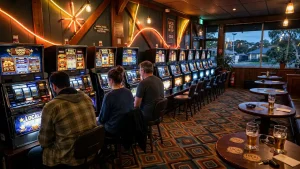
That point should not be stretched into claims about how a specific free mode operates. The general RNG principle does not verify that a no-stakes version exists, that it uses the same settings as any real-money game, or that its presentation matches a particular product. It supports only a limited statement about the independence and randomness of individual spins. Any further claim about a named free option would require information specific to that option.
No-stakes play can therefore be understood as a category, not as proof of availability. If a site or game description uses the word “free”, the word needs to be read alongside the actual terms and the activity being described. A page mentioning free play does not necessarily provide a game, and a game presented without a stake cannot be assumed to represent every aspect of real-money play. Those distinctions are especially important where the name “Big Red” appears, because a search phrase or heading is not evidence of a particular implementation.
The same caution applies to expectations. A run of wins or losses in a no-stakes setting does not establish a pattern that can be carried over to another session. Since spins are independent random events, previous outcomes offer no basis for predicting the next one. Nor does a free result establish what would happen if money were involved. It is not evidence of a likely return, a payout rate, or the behaviour of a separate version.
This makes “free” a description of the stake context, not a guarantee about the game or its results. It may signal that no money is being wagered, but that interpretation should not be confused with a confirmed Big Red feature. The distinction is between the possible meaning of the label and the facts it actually establishes: no-stakes play is conceptually different from real-money gambling, while the result of any individual spin remains random.
Big Red Pokies and Australia’s Online Gambling Rules
Casinos listed by licence
Choosing big red pokies online in Australia means checking the practical details behind the play, including licensing and payment terms. Use these operator notes as a starting point and verify current terms before signing up.
-
Roby Casino
- License
- Curacao eGaming (Roby Games Ltd)
Roby Casino is listed with a Curacao eGaming licence held by Roby Games Ltd.
-
Neospin
- License
- Curacao Gaming Control Board OGL/2023/176/0095 (Hollycorn N.V.)
Neospin holds a Curacao Gaming Control Board licence, OGL/2023/176/0095, under Hollycorn N.V.
-
WinSpirit Casino
- License
- Curacao eGaming OGL/2024/923/0383 (Antillephone N.V.)
- Min. deposit
- A$30
WinSpirit Casino lists a Curacao eGaming licence, OGL/2024/923/0383, under Antillephone N.V. Its minimum deposit is A$30.
-
Vegaz Casino
- License
- Curacao OGL/2024/1335/0780
- Min. deposit
- EUR 20
Vegaz Casino is listed with Curacao licence OGL/2024/1335/0780. Its minimum deposit is EUR 20.
-
House of Pokies
- License
- international iGaming licence – jurisdiction not named in the source
- Payout speed
- PayID 1-24 hours
- Min. deposit
- A$30 (PayID from A$10)
House of Pokies lists an international iGaming licence, though the jurisdiction is not named in the source. PayID payouts are stated as taking 1–24 hours; the minimum deposit is A$30, or A$10 when using PayID.
-
DragonSlots Casino
- License
- Curacao Gaming Authority (Jumpman Gaming Ltd)
DragonSlots Casino is listed with a Curacao Gaming Authority licence held by Jumpman Gaming Ltd.
-
Ricky Casino
- Payout speed
- crypto under 1 hour, PayID 1-3 business days
- Min. deposit
- A$20 (A$30 to qualify for the bonus)
Ricky Casino states that crypto payouts take under an hour and PayID payouts take 1–3 business days. The minimum deposit is A$20, rising to A$30 to qualify for the bonus.
-
Wild Tokyo
- License
- Curacao
- Payout speed
- crypto 30-60 minutes, fiat 1-5 days
- Min. deposit
- A$10
Wild Tokyo lists a Curacao licence and a minimum deposit of A$10. Its stated payout times are 30–60 minutes for crypto and 1–5 days for fiat.
-
Rollero Casino
- License
- Curacao Gaming Control Board OGL/2023/176/0095 (Hollycorn N.V.)
Rollero Casino holds a Curacao Gaming Control Board licence, OGL/2023/176/0095, under Hollycorn N.V.
-
Lucky Dreams
- License
- Curacao
- Min. deposit
- A$20 (POLi)
Lucky Dreams lists a Curacao licence and a minimum deposit of A$20 when using POLi.
The legal position for real-money online pokies in Australia is defined by the Interactive Gambling Act 2001. The Act prohibits companies from providing real-money online casino games, including pokies, to people in Australia unless the operator holds a domestic licence. No such licences have been issued, and there is no Australian-licensed online casino.
This distinction matters when considering the phrase “Big Red pokies” in an Australian context. A game name or theme does not determine whether an online service may legally offer real-money play. The relevant issue is the service being provided: an online pokie played for money falls within the category of casino-style gambling covered by the Act. Describing a service as international, online or locally accessible does not itself change the domestic licensing position.
The absence of Australian-licensed online casinos is not a gap that allows an operator to treat an overseas authorisation as an Australian one. A licence issued in another jurisdiction is not a domestic licence under the Interactive Gambling Act. Nor does a website’s Australian-facing presentation establish that it is authorised to provide real-money online pokies in Australia. The legal framework concerns the operator’s provision of the service, rather than the wording used to describe a game or the site.
Licensing Warning
Real-money online casino games are prohibited in Australia unless the operator holds a domestic licence, and no such licences have been issued.
The Australian Communications and Media Authority (ACMA) is the primary domestic regulator responsible for enforcing the Interactive Gambling Act 2001. Its role places the law’s operator restrictions within a national regulatory framework. The central point is that real-money online casino services are not part of a domestically licensed online-casino market: the Act prohibits their provision to people in Australia, and no Australian online-casino licences have been issued.
That framework should not be confused with the regulation of land-based gambling. Rules applying to physical venues do not create an Australian licence for an online casino, and the existence of gambling regulation in other settings does not establish that a real-money online pokie service is authorised. The online service must be considered under the law governing interactive gambling.
Similarly, a game’s branding does not establish its legal status. “Big Red” may be used as a search phrase for online pokies, but a name alone cannot show whether a particular product is available, who operates it or what legal authority applies to its provision. Those questions are separate from the general rule: a company may not provide real-money online pokies to people in Australia without a domestic licence, and none has been issued.

The distinction between a game and the service offering it is also important. The legal restriction concerns companies providing real-money online gambling services, not simply the existence of a game title or the use of a particular device. A name appearing in promotional material or on a website would not, by itself, demonstrate that the service has Australian authorisation. Conversely, the absence of a domestic online-casino licensing system means there is no Australian online-casino licence against which such a service could be validated.
The law therefore does not support treating “Big Red pokies Australia” as a category of locally licensed online gambling. It is more accurate to understand the phrase as a reference to a search interest in a game or style of pokie, while keeping the regulatory position distinct: real-money online casino games are prohibited for operators serving people in Australia unless a domestic licence exists, and no such licences have been granted.
The established national position is narrower and clearer: the Interactive Gambling Act 2001 governs the provision of real-money online pokies, ACMA enforces that Act, and Australia has no licensed online-casino market.
Real-Money Play: Legal Exposure and Withdrawal Checks
The legal exposure associated with real-money pokies in Australia falls principally on the service provider, rather than on an individual player. The Interactive Gambling Act 2001 prohibits operators from offering online casino games to people in Australia without a domestic licence, and none has been issued. Australians are not criminally liable simply for playing on an offshore site that accepts them. That distinction does not make an offshore casino an Australian-regulated service or provide local protection if a dispute arises.
The practical risk is clearest when a site does not pay winnings. An Australian player has no legal recourse in Australia against an offshore casino that refuses to pay. A complaint may therefore lack an effective domestic route to resolve it, even where the disagreement concerns an account balance or a withdrawal. The fact that a site accepts Australian customers does not itself establish that its obligations can be enforced through Australian institutions.
This matters when considering real-money play associated with a named pokie. The name of a game does not alter the legal or financial relationship: a deposit and any resulting withdrawal are handled under the offshore operator’s terms. Those terms may set conditions for account verification and payment, while Australian remedies against the operator are not available if it withholds winnings. No conclusion about the reliability of a particular site follows merely from its willingness to accept a player from Australia.

Identity checks are another material condition of cashing out. A specialist review source reports that casinos commonly require verification before a first withdrawal. The requested documents may include a photograph of identity documentation and proof of address; some operators may also ask for a photograph showing the account holder holding that document. These requirements can make a withdrawal dependent on more than the account balance: the submitted details must also satisfy the operator’s checks. The exact process is set by the site, so the reported practice should not be treated as a guarantee about every operator.
Verification is not the same as domestic oversight. Providing identity and address documents may be an operator’s condition for processing a withdrawal, but it does not give the player an Australian licensing authority to appeal to if the process is delayed or the payment is refused. Nor does completing a check settle the underlying question of whether the operator will honour its terms. The lack of local legal recourse remains relevant after documents have been submitted.
BetStop also has a limited role in this context. It applies to Australian-licensed operators and does not bind offshore sites. Since there is no Australian-licensed online casino, BetStop should not be understood as a control that prevents an offshore casino from accepting an account or allowing real-money play. It does not resolve a withdrawal dispute with an offshore operator either.
For any assessment of real-money exposure, the key distinction is therefore between the player’s legal position and the operator’s conduct. Australian players are not the target of the Interactive Gambling Act’s prohibition on supplying online casino services, but they may still face financial consequences when using an offshore site. A withdrawal can depend on document checks, and refusal to pay winnings may leave no legal remedy in Australia.
How a Pokie Spin Is Determined
A pokie spin is governed by a Random Number Generator (RNG): the outcome is selected through a random process, and each spin is independent of the one before it. This describes the basic relationship between a spin and its result. It does not mean that a sequence of outcomes follows a pattern that can be read from earlier results.
Independence matters because a previous result does not set the result of the next spin. A win does not make another win due, and a run of losses does not make a win more likely on the following spin. The same principle applies in reverse: a run of wins does not establish that the next outcome will be a loss. Each new spin is a separate random event.
This can be counterintuitive when outcomes appear in clusters. Several similar results in succession may look like a developing trend, but a short sequence does not change the independence of the next spin. Looking back at outcomes can describe what has already happened; it cannot determine what will happen next. A perceived pattern is not a reliable basis for predicting an individual result.
The distinction is between randomness and a guarantee that every short stretch will look evenly balanced. Independent random events can produce sequences that seem unusual or repetitive. Their appearance does not, by itself, show that a later result has been influenced by them. Nor does it establish a cycle in which wins and losses must alternate or balance out within a particular session.

For someone interested in how Big Red pokies play, the relevant general point is therefore about the individual spin, not a sequence strategy: the RNG determines the result, and the next spin remains independent of earlier results. This does not provide a way to forecast a particular outcome. Knowing what appeared previously cannot reveal the result that will be selected for a subsequent spin.
The same explanation applies whether outcomes are considered one at a time or as a longer record. A history can show the order in which results occurred, but it does not turn those results into instructions for the next event. Extending the record with more past spins does not remove the independence of a new spin. Each outcome must be understood as its own event rather than as a response to the sequence that came before.
It is also useful to distinguish an explanation of randomness from a claim about any specific game feature. The RNG principle concerns how an individual pokie spin is determined at a general level. It does not, on its own, describe a game’s symbols, special features, or the probability of a particular result. Those are separate matters from the independence of successive spins.
Accordingly, the soundest account of a spin is limited but clear: an RNG selects its result, and prior outcomes do not determine the next one. Past play may invite interpretation, especially when a sequence appears striking, but it does not offer a dependable signal about what the next spin will produce.
Free Online Play and the Limits of What Can Be Verified
Interest in playing Big Red pokies online without staking money raises two separate questions: whether a free-play version of a particular game is available, and what can be concluded about its outcomes if it is. The first cannot be answered from the game name or from the general fact that pokies use random number generation.
The distinction matters because “free play” can describe different arrangements. It may refer to a practice mode that uses no cash, promotional access, or simply a request to try a game before deciding whether to play for money. Those descriptions are not interchangeable, and none confirms that a Big Red version is available online.
There is one relevant general point about how outcomes are generated: a pokie spin is produced by a Random Number Generator, and each spin is separate from the one before it. That describes the relationship between successive outcomes. It does not identify a particular online version, establish that it has a free mode, or confirm that a free and paid mode are offered for the same game.
Nor does the general RNG principle show that a free-play arrangement reproduces every condition of real-money play. A free mode might be designed in a particular way, but that possibility is not evidence about any named game. The game title alone cannot establish whether the displayed reels, rules, or settings match another version. Such details require specific information about the product and its implementation.

The same caution applies to claims about what free play can demonstrate. If a mode were confirmed, observing its results could show what happened during those particular spins. It would not establish a pattern that predicts later results: because spins are independent, previous outcomes do not determine the next one. A short sequence of play also cannot, on its own, verify broader claims about a game’s design or settings. Those are separate matters from the randomness of individual outcomes.
Accordingly, the careful answer to requests to play Big Red pokies online for free is limited. It also cannot substantiate descriptions of its interface, access requirements, or equivalence to real-money play.
This distinction keeps two kinds of statements separate. One concerns a general property of pokie outcomes; the other concerns the availability and characteristics of a particular product. The former does not supply the missing details for the latter.
Big Red Demo Pokies: What the Evidence Establishes
A “demo” label generally describes a version of a pokie intended for play without staking money. Applying that label to Big Red, however, does not establish that a particular demo exists or that it can be accessed online. The name alone is not evidence of a specific game mode, provider, interface or set of features.
This distinction matters because terms used to describe games can be repeated across pages without confirming that they refer to the same product. A page title or promotional description, by itself, does not show whether a demo is available, how it operates or whether it represents a particular real-money game. Those details require information tied to an identifiable game and its publisher; they should not be inferred from the word “demo”.
Demo Mode Characteristics
A demo label describes a version of a pokie intended for play without staking money, but it does not guarantee that the version matches the real-money game's settings or rules.
Each spin is generated by a Random Number Generator (RNG), and its result is independent of earlier spins. That general property does not demonstrate that a Big Red demo exists. Nor does it establish that any particular version uses the same settings, presentation or game rules as another version bearing a similar name.
Consequently, claims about a Big Red demo’s availability or functionality cannot be treated as established merely because the phrase is used. The distinction is between a general description of demo play and evidence for a named product: the former does not prove the latter.
Big Red Pokies Games and Variable RTP Settings
A game’s return to player (RTP) should not be treated as a fixed figure shared across every casino that offers it. A specialist review reports that some game providers give casinos a choice of RTP settings for a particular pokie. Where that arrangement applies, the same game may therefore operate with different return percentages at different venues.
This qualification matters when comparing descriptions of pokies. An RTP figure attached to a game name is not necessarily a universal specification: it may reflect a particular casino’s configuration rather than every version of the game. Conversely, the existence of different possible settings does not establish that every provider offers a choice, or that every casino changes the setting. The reported practice is limited to some providers and should not be generalised across the market.
A game title alone also cannot show which setting applies in a particular instance. A published percentage would need to be tied to the casino’s version of the game to support a comparison. Without that connection, figures presented in separate listings may refer to different configurations, and apparent differences cannot automatically be attributed to the game’s title or mechanics.

RTP is a statistical measure, not a forecast of what an individual session will return. It does not determine the outcome of a particular spin, nor does a higher stated percentage guarantee a better result for any single player. Comparisons are meaningful only when the relevant game and setting are identified; a percentage without that context can give a misleading impression of precision.
For searches about Big Red pokies games, the same standard of evidence applies: a game label or an RTP figure should not be taken as proof of a particular configuration. The useful distinction is between a provider’s possible settings and the setting attached to a specific casino offering. Where that information is not clearly stated, a precise cross-casino comparison is not supported.
Accordingly, RTP claims are best read as configuration-specific rather than as an inherent, unchanging property of a title. The available reporting supports the narrower point that some providers permit selection among multiple settings. It does not support a particular percentage for a Big Red-branded game, or a claim that every casino uses the same return setting.
Downloads, Site Blocking and Access Limits
A request for a Big Red pokies download can refer to different things: a mobile app, a game installed on a computer, or a shortcut that opens a website. Those are distinct ways of accessing software, and the word “download” alone does not establish that a particular game or app is available.
A downloadable file would not, by itself, change the status of the service it connects to. If software provides access to an offshore gambling site, installing it does not make that site locally licensed or remove the restrictions that apply to access. Nor does an app label establish who operates the service, what it contains, or whether it is accessible in Australia.
Access can also be affected by regulatory blocking. The Australian Communications and Media Authority (ACMA) maintains a blocklist for illegal offshore gambling sites, and internet service providers must implement the resulting access restrictions. A site may therefore be unavailable through an Australian internet connection after it has been blocked. A separate app or downloaded file should not be assumed to bypass that restriction; the blocking measure concerns access to the service, not merely the appearance of its website in a browser.
This distinction matters when interpreting claims about availability. A page, app listing or file name is not, on its own, confirmation that a named Big Red game exists as downloadable software. Likewise, a download link does not establish that the service is lawful or that it can be reached from Australia. The relevant facts are the nature of the service and whether access to it is restricted, rather than whether an icon or installation file is offered.
The phrase “Big Red pokies download” can therefore describe an intended format, but it does not demonstrate that a particular product is offered in that format. ACMA’s access-blocking role supplies a separate part of the picture: where an offshore gambling site is blocked, internet providers are required to apply that block. These points should not be conflated. A downloadable format is not evidence of availability, and it does not negate an access restriction.
Big Red Kangaroo Pokies: No Verified Game-Specific Details
“Big Red Kangaroo” may suggest a pokie built around Australia’s familiar animal imagery, but the name alone does not identify a particular game. It cannot establish that a title with that exact name exists, where it might be available, or what its symbols, bonus features, or presentation would be. Those details should not be inferred from the wording.
 Casino Dice Games in Australia: Rules and FormatsLearn how dice outcomes define casino games, how craps and other formats work, and what the term live casino dice means.
 Online pokies for real money in Australia: legal guideLearn how the Interactive Gambling Act 2001 treats operators, why no domestic online casino is licensed, and what payments and safeguards can—and…
 Pokies in Geelong: what can be verifiedA grounded guide to what venue listings can establish, how to read pokie outcomes, and why opening hours and airport claims remain…
The distinction matters because a descriptive phrase can resemble a game title without uniquely identifying a product. “Big Red” might be used as branding, while “kangaroo” could describe a theme or appear in a search for related content. Without a clearly identified title, claims about a specific game’s mechanics or features would be speculation. The phrase itself is not evidence of a particular pokie.
One general point applies to pokie play: the outcome of each spin is generated randomly, and a spin does not depend on the result of the one before it. That fact describes how individual spins are determined in general. It does not confirm that a kangaroo-themed game exists, nor does it establish the rules, symbols, bonus rounds, or return settings of any game described as “Big Red Kangaroo”.
This also means that an apparent theme cannot support predictions about outcomes. A kangaroo symbol, if present in a game, would not make a later spin more or less likely to produce a particular result. Each new spin is determined independently, rather than carrying forward a pattern from previous play. General knowledge about random outcomes should therefore be kept separate from claims about a named title.
A reliable description of a particular pokie would need to identify the game itself before its characteristics could be stated. In the absence of that identification, details such as a feature round, reel layout, or payout profile should not be attributed to “Big Red Kangaroo”. A title that sounds plausible is not enough to establish those particulars.
Accordingly, the phrase is best treated as a broad description rather than a confirmed game identity. The general operation of pokie spins can be described, but game-specific statements about a kangaroo-themed Big Red title cannot be drawn from the name alone.
What is the legal age for online gambling in Australia?
You must be at least 18 to gamble in Australia, including on online pokies.
What does “wagering requirement” actually mean?
It is the amount you must bet before you can withdraw bonus-related winnings, usually expressed as a multiplier. For example, a $500 bonus with a 40x requirement means $20,000 in bets.
What’s the best strategy for playing pokies?
No strategy can predict the next spin: each result is random and independent of previous spins.